
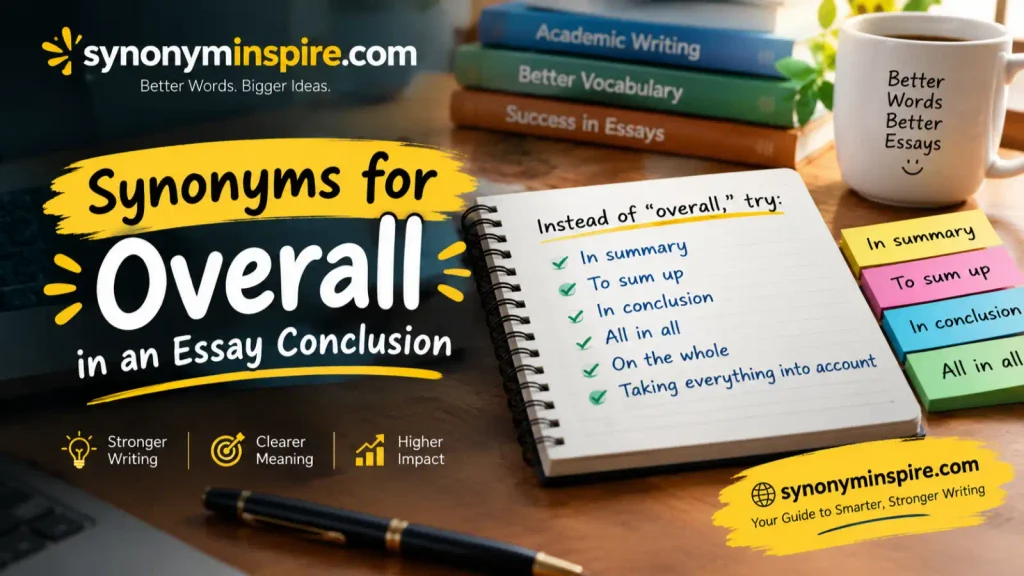
synonyms for overall in an essay conclusion, the best choice depends on what you want your final sentence to do. Words and phrases such as on the whole, in summary, all things considered, taken together, ultimately, in essence, broadly speaking, and in conclusion can help you avoid repetition while keeping your academic writing clear.
The key is not to replace overall with any phrase that simply sounds formal. Some alternatives summarize an argument, some show a final judgment, and others describe the general picture. This guide explains those differences so you can choose wording that fits your essay rather than forcing a synonym into the sentence.
Quick Answer
Useful alternatives to overall in an essay conclusion include on the whole, in summary, all things considered, taken together, ultimately, in essence, broadly speaking, in general, collectively, in sum, and in conclusion. Choose based on meaning: some summarize evidence, while others signal a final judgment or restatement.
39+ Alternatives at a Glance
Here are more than 39 useful alternatives, grouped by how naturally they work in an essay conclusion.
Closest alternatives
- On the whole
- In general
- All in all
- Taken as a whole
- As a whole
- In sum
- In summary
- To summarize
- In essence
- Broadly speaking
Formal academic alternatives
- All things considered
- Taken together
- Collectively
- Ultimately
- In the final analysis
- On balance
- In the aggregate
- Considering all factors
- Taking everything into account
- Viewed as a whole
Neutral alternatives
- In short
- To sum up
- In brief
- Overall speaking
- By and large
- Generally
- Generally speaking
- In broad terms
- In the main
- For the most part
Contextual alternatives
- The evidence suggests
- The findings indicate
- The discussion shows
- The analysis demonstrates
- The results suggest
- This evidence points to
- Considering the evidence
- Looking at the issue as a whole
- From the evidence presented
- When considered together
- Taking the findings together
- Considering the broader picture
- At its core
- In the final assessment
Not all 44 expressions are interchangeable with overall. For example, “the evidence suggests” introduces a conclusion based on evidence, while “on the whole” simply gives a broad assessment.
Formal Alternatives for Academic Conclusions
Academic conclusions benefit from precision. You do not always need a complicated phrase; in fact, a simple expression can sound more natural and authoritative than an overly formal one.
1. On the whole
Meaning: Considering something in its entirety.
Explanation: This is one of the closest natural alternatives to overall. It works especially well when your conclusion balances several positive and negative points.
Example:
“On the whole, the evidence supports the argument that early education improves long-term outcomes.”
Best Use: Essays, analytical writing, evaluations.
Worst Use: A sentence where you need to introduce a specific final finding rather than a broad assessment.
Tone: Formal to neutral.
2. All things considered
Meaning: After considering all relevant factors.
Explanation: This phrase emphasizes that several pieces of evidence or competing factors have been weighed before reaching a conclusion.
Example:
“All things considered, public transportation remains a practical solution for reducing urban congestion.”
Best Use: Evaluative essays and argumentative conclusions.
Worst Use: A simple factual summary that does not involve weighing different factors.
Tone: Formal and thoughtful.
3. Taken together
Meaning: Considered collectively rather than separately.
Explanation: This is particularly useful when your essay has discussed several studies, arguments, findings, or examples.
Example:
“Taken together, these findings suggest that regular exercise can support both physical and mental well-being.”
Best Use: Research papers and evidence-based essays.
Worst Use: When there is only one piece of evidence.
Tone: Academic and precise.
4. In summary
Meaning: As a brief statement of the main points.
Explanation: This directly signals that you are summarizing what has already been discussed.
Example:
“In summary, the three approaches offer different solutions to the problem of water scarcity.”
Best Use: Academic essays, reports, presentations.
Worst Use: When your final sentence introduces a new argument.
Tone: Formal and clear.
5. In essence
Meaning: In the most basic or fundamental sense.
Explanation: This is not a perfect synonym for overall. It reduces a complex discussion to its central idea.
Example:
“In essence, the debate concerns how society should balance individual freedom with public responsibility.”
Best Use: Conclusions that identify the central issue.
Worst Use: When you simply need to summarize several unrelated findings.
Tone: Formal.
6. Ultimately
Meaning: At the final point of consideration; in the end.
Explanation: Ultimately often emphasizes the final result or judgment rather than merely summarizing information.
Example:
“Ultimately, effective environmental policy depends on cooperation between governments, businesses, and communities.”
Best Use: Argumentative conclusions and final judgments.
Worst Use: A neutral summary where no final outcome is being established.
Tone: Formal and confident.
7. On balance
Meaning: After weighing advantages, disadvantages, or competing considerations.
Explanation: This phrase is useful when an essay presents both sides of an issue before reaching a measured conclusion.
Example:
“On balance, the benefits of renewable energy outweigh the short-term costs.”
Best Use: Compare-and-contrast and argumentative essays.
Worst Use: A conclusion that does not involve weighing alternatives.
Tone: Formal.
8. In sum
Meaning: In total; as a concise summary.
Explanation: A compact academic phrase that signals a summary of the main argument.
Example:
“In sum, the evidence provides strong support for the proposed explanation.”
Best Use: Academic and professional writing.
Worst Use: Very informal conversation.
Tone: Formal and concise.
9. In the final analysis
Meaning: After examining the matter fully.
Explanation: This phrase suggests that the conclusion follows from a complete examination of the issue.
Example:
“In the final analysis, successful reform requires both institutional change and public support.”
Best Use: Formal essays and analytical writing.
Worst Use: Short school assignments where simpler language would be clearer.
Tone: Highly formal.
10. Considering all factors
Meaning: Taking all relevant elements into account.
Explanation: This is a contextual alternative rather than a direct synonym. It works when your conclusion weighs multiple variables.
Example:
“Considering all factors, the proposed strategy offers a reasonable response to the challenge.”
Best Use: Evaluation and analysis.
Worst Use: A conclusion with only one relevant factor.
Tone: Formal.
11. Taking everything into account
Meaning: After considering all relevant information.
Explanation: Similar to all things considered, but slightly more explicit.
Example:
“Taking everything into account, the policy appears to address several of the concerns identified in the study.”
Best Use: Balanced arguments.
Worst Use: When the conclusion is meant to be brief and direct.
Tone: Formal to neutral.
12. Collectively
Meaning: As a group rather than individually.
Explanation: This is useful when referring to multiple studies, factors, examples, or findings.
Example:
“Collectively, these examples demonstrate the importance of reliable public infrastructure.”
Best Use: Research-based conclusions.
Worst Use: A single argument or isolated fact.
Tone: Formal academic.
13. Viewed as a whole
Meaning: Considered in its entirety.
Explanation: This closely matches the broad meaning of overall and can make a conclusion sound deliberate without becoming unnecessarily complicated.
Example:
“Viewed as a whole, the evidence presents a consistent picture of gradual economic change.”
Best Use: Analytical essays and reports.
Worst Use: Casual writing.
Tone: Formal.
14. Broadly speaking
Meaning: Generally, without focusing on every detail.
Explanation: This is a useful alternative when your statement describes a general pattern rather than an absolute conclusion.
Example:
“Broadly speaking, the results support the original hypothesis.”
Best Use: General academic observations.
Worst Use: When exact data or a precise finding is required.
Tone: Neutral to formal.
15. Taken as a whole
Meaning: Considered collectively.
Explanation: Very close to viewed as a whole. It works particularly well when several arguments or observations have been presented.
Example:
“Taken as a whole, the arguments reveal the complexity of the issue.”
Best Use: Analytical and argumentative essays.
Worst Use: A conclusion based on one narrow point.
Tone: Formal.
Semi-Formal and Neutral Alternatives
Some essays do not need highly formal language. These alternatives can make your writing smoother while still sounding appropriate for school, college, or general academic work.
16. In general
Meaning: Usually or broadly.
Example:
“In general, the survey results support the proposed conclusion.”
Best Use: Broad observations.
Worst Use: Precise findings that require qualification.
Tone: Neutral.
17. Generally speaking
Meaning: Speaking in broad rather than specific terms.
Example:
“Generally speaking, the participants responded positively to the revised approach.”
Best Use: Broad observations.
Worst Use: A conclusion that needs exact statistical detail.
Tone: Neutral.
18. In short
Meaning: Briefly summarizing the main point.
Example:
“In short, the argument depends on balancing economic growth with environmental protection.”
Best Use: Concise conclusions.
Worst Use: Extremely formal research writing where a more academic transition may be preferable.
Tone: Neutral.
19. To sum up
Meaning: To summarize the main points.
Example:
“To sum up, the evidence supports a more flexible approach to education.”
Best Use: School essays, presentations, general writing.
Worst Use: Legal or highly formal academic documents.
Tone: Neutral.
20. In brief
Meaning: In a concise form.
Example:
“In brief, the study highlights three major challenges facing rural communities.”
Best Use: Short summaries.
Worst Use: A lengthy analytical conclusion where more explanation is needed.
Tone: Neutral to formal.
21. By and large
Meaning: Generally; for the most part.
Example:
“By and large, the proposed changes produced positive results.”
Best Use: General evaluation.
Worst Use: Formal scientific writing where precise wording is preferred.
Tone: Neutral.
22. In broad terms
Meaning: At a general level.
Example:
“In broad terms, the two theories share similar assumptions about human behavior.”
Best Use: Comparing theories or approaches.
Worst Use: Detailed conclusions requiring exact distinctions.
Tone: Neutral/formal.
23. In the main
Meaning: Mostly or generally.
Example:
“In the main, the evidence confirms the pattern identified earlier in the essay.”
Best Use: Conclusions with minor exceptions.
Worst Use: When every part of the evidence points in exactly the same direction.
Tone: Formal-neutral.
24. For the most part
Meaning: Mostly, but not completely.
Example:
“For the most part, the participants agreed with the proposed changes.”
Best Use: Conclusions containing exceptions.
Worst Use: When you intend to claim something is universally true.
Tone: Neutral.
25. All in all
Meaning: Considering everything.
Example:
“All in all, the project demonstrated the value of early planning.”
Best Use: General summaries.
Worst Use: Highly formal academic research.
Tone: Neutral and slightly conversational.
Informal / Casual Alternatives
There are not many genuinely casual replacements that preserve the exact function of overall. Most informal options sound more natural in conversation than in academic essays.
26. All in all
This is the strongest casual-friendly option.
Example:
“All in all, the experience was worthwhile.”
When natural: Personal reflections and informal writing.
When to avoid: Formal research papers.
Tone: Casual to neutral.
27. In short
Although perfectly acceptable in many essays, in short has a conversational feel.
Example:
“In short, the plan worked better than expected.”
When natural: Short essays, presentations, personal writing.
When to avoid: When the conclusion requires a detailed qualification.
Tone: Neutral/casual.
28. To sum it up
This is more conversational than in summary.
Example:
“To sum it up, the evidence points toward a need for reform.”
When natural: Speeches, classroom discussions, informal explanations.
When to avoid: Highly formal academic papers.
Tone: Casual.
29. Basically
Basically can summarize a central idea, but it is not a direct synonym for overall.
Example:
“Basically, the study shows that access matters as much as quality.”
When natural: Conversation and informal explanation.
When to avoid: Formal academic conclusions.
Tone: Casual.
True Synonyms vs. Contextual Alternatives
| Type | What It Means | Can It Replace “Overall”? |
|---|---|---|
| True synonym | Has nearly the same broad meaning | Usually |
| Near synonym | Similar meaning with a small difference | Sometimes |
| Contextual alternative | Works in a particular sentence or purpose | Only in suitable contexts |
| Broader expression | Covers a wider idea than overall | Sometimes |
| Narrower expression | Focuses on one specific aspect | Only when that aspect is intended |
Examples make the distinction clearer:
- On the whole → very close synonym.
- In general → near synonym because it often means “generally,” not necessarily “after considering everything.”
- Ultimately → contextual alternative because it focuses on the final conclusion.
- Taken together → contextual alternative because it normally refers to multiple pieces of evidence.
- The evidence suggests → broader contextual expression because it emphasizes evidence and uncertainty.
- In essence → narrower contextual alternative because it identifies the central meaning rather than giving a complete overview.
This distinction matters because replacing overall mechanically can accidentally change your argument.
Using These Alternatives in Different Types of Writing
Business Writing
For business reports, overall, on the whole, taken together, in summary, and ultimately are generally natural choices.
Example:
“Overall, customer feedback indicates that the revised service process has reduced delays.”
You could write:
“Taken together, customer feedback indicates that the revised service process has reduced delays.”
The second version works particularly well if several feedback categories were discussed.
Corporate Communication
Reports and internal documents often benefit from precise phrases such as:
- In summary
- Collectively
- Considering all factors
- On balance
- The findings indicate
Example:
“Collectively, the quarterly results indicate that the department has made steady progress.”
Academic Writing
Academic conclusions should prioritize clarity over decorative vocabulary. Strong choices include:
- On the whole
- Taken together
- In sum
- Ultimately
- All things considered
- The evidence suggests
- The findings indicate
For an essay, in summary is also useful, but avoid adding a conclusion phrase to every paragraph.
Customer Service
Customer-facing writing usually benefits from plain language:
“Overall, your experience appears to have been positive.”
A natural alternative might be:
“Based on your feedback, your experience appears to have been positive.”
This is not a true synonym, but it makes the source of the assessment clear.
Legal Writing
Legal writing requires particular care. Overall, generally, broadly, and similar terms can sometimes be too vague if a statement needs a precise legal definition or scope.
For example, replacing a specific legal statement with “on the whole” could weaken its precision.
A legal document should preserve the exact intended meaning and jurisdiction-specific terminology. A general synonym list should not be treated as legal drafting advice.
Email Communication
For professional emails, use straightforward phrases:
- Overall
- In summary
- To summarize
- Taken together
- Based on the information available
- At this stage
For example:
“In summary, the proposed schedule meets the project requirements, although the final delivery date remains subject to confirmation.”
Email Examples
Email 1 — Academic Update
Subject: Summary of the Research Findings
EmailSummary of the Research Findings
Summary of the Research Findings
Hello Professor Adams,
In summary, the research indicates that access to digital resources had a noticeable effect on student participation. The results also suggest that access alone was not enough; reliable guidance and technical support played an important role.
Best,
Maya
Email 2 — Project Review
Subject: Project Review Summary
EmailProject Review Summary
Project Review Summary
Hi Daniel,
Taken together, the feedback from the three review sessions points to a few minor design changes rather than a need to revise the entire project.
I’ve included the main comments below for reference.
Thanks,
Elena
Email 3 — Client Follow-Up
Subject: Follow-Up on Your Request
EmailFollow-Up on Your Request
Follow-Up on Your Request
Hello Mr. Chen,
All things considered, the revised delivery schedule should meet your requirements. The only remaining issue is confirmation from the shipping team.
I’ll send an update as soon as that information is available.
Regards,
Jordan
Email 4 — Team Communication
Subject: Quarterly Results
EmailQuarterly Results
Quarterly Results
Hi everyone,
Overall, the quarter showed steady progress, particularly in customer retention and response times. There are still a few areas that need attention, but the results give us a useful foundation for the next quarter.
Best,
Nora
Email 5 — Student Reflection
Subject: Final Essay Reflection
EmailFinal Essay Reflection
Final Essay Reflection
Dear Dr. Patel,
On the whole, the evidence supports the argument presented in my essay. However, the research also revealed several limitations that may affect how broadly the findings can be applied.
Thank you for your feedback throughout the semester.
Sincerely,
Marcus
Short Dialogue Examples
Workplace
Person A: How did the new process perform?
Person B: On the whole, it worked well, although we still need to address the reporting delays.
Classroom
Person A: What did you conclude from the article?
Person B: In essence, the author argues that technology changes how people learn rather than simply making learning easier.
Customer Service
Person A: Was the replacement process successful?
Person B: Overall, yes. The customer received the replacement within the expected time.
Casual Conversation
Person A: How was your trip?
Person B: All in all, it was a great experience.
Professional Discussion
Person A: What do the three studies tell us?
Person B: Taken together, they suggest that the issue is more complicated than the first study indicated.
Sentence Transformations
1. Broad conclusion
Original:
“Overall, the evidence supports the argument.”
Alternative:
“On the whole, the evidence supports the argument.”
Why it works:
On the whole is one of the closest replacements and preserves the broad meaning.
2. Summary
Original:
“Overall, the essay shows that education can reduce inequality.”
Alternative:
“In summary, the essay shows that education can reduce inequality.”
Why it works:
The emphasis changes slightly from a general assessment to a summary.
3. Multiple findings
Original:
“Overall, the findings support the hypothesis.”
Alternative:
“Taken together, the findings support the hypothesis.”
Why it works:
This specifically highlights several findings being considered collectively.
4. Final judgment
Original:
“Overall, the policy has several benefits.”
Alternative:
“Ultimately, the policy has several benefits.”
Why it works:
Ultimately emphasizes the final assessment rather than simply the broad picture.
5. Balanced argument
Original:
“Overall, the advantages outweigh the disadvantages.”
Alternative:
“On balance, the advantages outweigh the disadvantages.”
Why it works:
On balance clearly signals that competing considerations were weighed.
6. Central idea
Original:
“Overall, the debate concerns equality and access.”
Alternative:
“In essence, the debate concerns equality and access.”
Why it works:
The alternative focuses on the fundamental idea behind the discussion.
7. Evidence-based conclusion
Original:
“Overall, the study supports the proposed explanation.”
Alternative:
“The findings indicate that the proposed explanation is supported.”
Why it works:
The sentence becomes more evidence-focused and avoids treating the alternative as a simple synonym.
8. General observation
Original:
“Overall, participants responded positively.”
Alternative:
“In general, participants responded positively.”
Why it works:
Both describe a broad pattern, although in general may leave more room for exceptions.
9. Complete assessment
Original:
“Overall, the project was successful.”
Alternative:
“All things considered, the project was successful.”
Why it works:
The revised version suggests that several factors were considered before reaching the judgment.
10. Concise ending
Original:
“Overall, the evidence points to a need for reform.”
Alternative:
“In sum, the evidence points to a need for reform.”
Why it works:
In sum gives the conclusion a concise academic feel.
Comparison Table
| Phrase | Tone | Meaning / Scope | Best Use | Example |
|---|---|---|---|---|
| Overall | Neutral | General assessment | Most essay types | “Overall, the evidence is convincing.” |
| On the whole | Formal-neutral | General assessment | Academic conclusions | “On the whole, the results are positive.” |
| In summary | Formal | Summary | Essay conclusions | “In summary, the evidence supports the claim.” |
| Taken together | Formal | Multiple items considered collectively | Research writing | “Taken together, the findings reveal a pattern.” |
| All things considered | Formal | Weighing several factors | Arguments | “All things considered, the policy is reasonable.” |
| Ultimately | Formal | Final judgment/result | Argumentative writing | “Ultimately, access remains the main issue.” |
| On balance | Formal | Weighing opposing points | Evaluations | “On balance, the benefits outweigh the costs.” |
| In essence | Formal | Central meaning | Conceptual conclusions | “In essence, the debate concerns fairness.” |
| In general | Neutral | Broad tendency | General observations | “In general, participants agreed.” |
| In sum | Formal | Concise summary | Academic writing | “In sum, the evidence is consistent.” |
| All in all | Neutral/casual | Overall assessment | Informal writing | “All in all, the project succeeded.” |
| Collectively | Formal | As a group | Multiple findings | “Collectively, the results support the theory.” |
| The evidence suggests | Academic | Evidence-based interpretation | Research essays | “The evidence suggests that the policy worked.” |
How to Choose the Right Alternative
Instead of searching for the “most impressive” synonym, identify the purpose of your conclusion.
For formal academic writing
Use on the whole, in sum, taken together, collectively, or in summary.
For argumentative essays
Consider ultimately, on balance, all things considered, or taking everything into account.
For research papers
Taken together, collectively, the findings indicate, and the evidence suggests are particularly useful.
For professional emails
Prefer overall, in summary, to summarize, or based on the information available.
For legal writing
Do not substitute a synonym simply to avoid repetition. Preserve the exact legal meaning and scope of the original statement.
For everyday conversation
All in all, in short, and generally speaking sound natural.
For a conclusion that emphasizes the central idea
Choose in essence or at its core rather than a simple summary phrase.
Grammar and Usage Guide
Use “overall” as an adverb
When overall summarizes an entire situation, it commonly appears at the beginning or end of a sentence.
Overall, the findings were positive.
The findings were positive overall.
“Overall” can also function as an adjective
In expressions such as:
“The overall result was encouraging.”
Here, overall describes the noun result.
Do not automatically replace this adjective with a phrase such as in summary.
Incorrect:
“The in summary result was encouraging.”
Correct:
“The overall result was encouraging.”
“On the whole” normally acts as a phrase
On the whole, the evidence supports the argument.
It should not normally be inserted directly before a noun as though it were an adjective.
“Taken together” needs something to be taken together
Taken together, the studies provide strong evidence.
This is different from:
Overall, the study provides strong evidence.
The first expression specifically points to multiple items.
“Ultimately” does not always mean “overall”
Compare:
Overall, the program was successful.
with:
Ultimately, the program led to significant changes.
The first provides a broad assessment. The second emphasizes the final outcome.
Avoid stacking conclusion phrases
Do not write:
“Overall, in summary, all things considered, the evidence suggests…”
One clear transition is usually enough.
Common Mistakes to Avoid
1. Treating every alternative as an exact synonym
Ultimately and overall are related, but they do different jobs. Choose according to meaning.
2. Using overly formal language
A simple phrase such as on the whole can be stronger than an unnecessarily elaborate expression.
3. Using casual phrases in formal essays
Basically and to sum it up may sound natural in conversation but can weaken the tone of a formal research paper.
4. Ignoring evidence
If your conclusion summarizes several studies, taken together may be more precise than overall.
5. Creating false certainty
If your evidence has limitations, the evidence suggests may be more accurate than a strong statement such as “the evidence proves.”
6. Repeating the same transition
Replacing overall with in summary five times does not improve style. Vary transitions according to their actual function.
7. Confusing summary with evaluation
In summary mainly introduces a recap. On balance suggests that competing considerations have been weighed.
8. Using “in essence” for a full summary
In essence identifies the central idea. It does not necessarily summarize every important point in an essay.
9. Choosing a synonym only because it sounds academic
Academic writing rewards precision, not complicated vocabulary. The clearest phrase is usually the better choice.
When Not to Replace “Overall”
You do not always need a synonym.
When “overall” is the clearest word
If your sentence simply gives a broad assessment, overall is concise and natural:
“Overall, the evidence supports the hypothesis.”
There is nothing wrong with keeping it.
When the sentence contains a precise technical meaning
If overall modifies a technical term, replacing it can change the intended meaning.
“The overall effect was statistically significant.”
A phrase such as in summary cannot replace the adjective here.
When you are writing for clarity
A synonym should not make the reader work harder. If overall is clearer than in the final analysis, use overall.
When the alternative changes the claim
If your evidence only indicates a possibility, do not switch to a phrase that implies certainty or a final judgment.
When repetition is not actually a problem
Using the same word once or twice is often better than replacing it with an unnatural synonym.
Advanced Writer Tips
Tone Control
Think about the exact job your transition performs. In summary summarizes. On balance weighs competing points. Ultimately highlights a final judgment. Taken together combines evidence.
Professional Email Etiquette
In emails, simple language usually communicates better than formal-sounding phrases. In summary is often more useful than in the final analysis.
Precision
Ask what your evidence actually allows you to say.
If several studies point in the same direction:
“Taken together, the findings suggest…”
If you are weighing benefits and disadvantages:
“On balance, the benefits appear to outweigh the drawbacks.”
Context Alignment
A conclusion to a literature review may need different wording from a personal reflection. Match the transition to the type of writing.
Readability
Do not replace a familiar word simply to demonstrate vocabulary. A clear conclusion is more effective than one packed with unusual expressions.
Avoid Formulaic Conclusions
You do not have to begin every final paragraph with “Overall” or “In conclusion.” Sometimes the strongest ending simply states the final insight directly.
For example:
“The evidence therefore points toward a more flexible approach to public transportation.”
This can be more direct than adding a conclusion marker.
Related Questions
What is another way to say “overall” in an essay?
Good alternatives include on the whole, in summary, taken together, all things considered, in sum, on balance, ultimately, and in essence. The best choice depends on whether you are summarizing, weighing evidence, or stating a final judgment.
What is a professional alternative to “overall”?
For professional writing, on the whole, in summary, taken together, collectively, and considering all factors are useful options. Choose the phrase that accurately describes the relationship between the evidence and your conclusion.
Is “overall” formal enough for an essay?
Yes. Overall is standard, clear, and appropriate for academic writing. There is no need to replace it merely because you want your essay to sound more formal.
Is “ultimately” the same as “overall”?
No. Ultimately usually emphasizes the final result, decision, or judgment, while overall describes the general picture. They can overlap in some conclusions but are not always interchangeable.
Is “in conclusion” better than “overall”?
Neither is automatically better. In conclusion explicitly signals the ending of an argument, while overall provides a broad assessment. The stronger option depends on what the sentence is trying to communicate.
Featured Snippet & AI Search Optimization
For a concise answer, remember this distinction:
Overall = the general picture.
On the whole = nearly the same broad meaning.
In summary = a recap of the main points.
Taken together = several pieces of evidence considered collectively.
On balance = competing factors weighed against each other.
Ultimately = the final result or judgment.
In essence = the central or fundamental idea.
This makes the alternatives easier to select without treating every expression as interchangeable.
FAQs:
What is the closest synonym for “overall” in an essay conclusion?
“On the whole” is one of the closest natural synonyms for overall when you mean “considering the entire situation.” It works well in academic conclusions because it preserves the broad meaning without sounding excessively formal.
Can I use “all things considered” instead of “overall”?
Yes, when your conclusion weighs multiple factors. All things considered suggests that different pieces of evidence, advantages, disadvantages, or circumstances have been considered before reaching the conclusion.
What can I use instead of “overall” in a research paper?
Useful choices include taken together, collectively, in summary, in sum, the findings indicate, and the evidence suggests. Evidence-focused alternatives can be more precise when your conclusion is based on several studies or results.
Is “in essence” a synonym for “overall”?
Not exactly. In essence means “at the fundamental level” or “in its most basic form.” It works when you want to identify the central idea rather than summarize every aspect of an argument.
What is the best alternative to “overall” for an argumentative essay?
There is no single choice for every argumentative essay. On balance works when weighing opposing considerations, while ultimately works when emphasizing the final judgment. All things considered is useful when several factors have been evaluated.
Can “in conclusion” replace “overall”?
Sometimes, but the two expressions have different functions. In conclusion signals that the writer is reaching the end of an argument. Overall describes the general assessment. Replacing one with the other can subtly change the sentence.
Should I use synonyms for “overall” throughout my essay?
Use alternatives only when they improve clarity or prevent unnecessary repetition. Academic writing does not require a different synonym every time a word appears. Repeating a precise word is often better than using an inaccurate replacement.
Key Takeaways
- On the whole is one of the closest replacements for overall when making a broad assessment.
- Taken together and collectively are especially useful when your conclusion combines multiple findings, studies, or examples.
- On balance signals that competing factors have been weighed, while ultimately emphasizes a final result or judgment.
- In summary and in sum focus on summarizing, whereas in essence focuses on the central idea.
- Keep overall when it is the clearest and most accurate option; a synonym is useful only when it adds precision, variety, or a better fit for the context.
Conclusion:
Choosing a replacement for overall in an essay conclusion is less about finding the fanciest word and more about identifying the exact meaning you want to convey.
On the whole is a close, natural substitute for a broad assessment. In summary and in sum work when you are recapping your main points, while taken together and collectively fit conclusions built around several findings or examples.
If your argument weighs opposing considerations, on balance is more precise. For a final judgment, ultimately can be stronger, while in essence is useful when you want to reduce a complex discussion to its central idea.
The most effective academic writing does not avoid overall at all costs. Instead, it uses the word when it is accurate and switches to another expression only when that expression communicates something more specific. The goal is clear, purposeful language not synonym variety for its own sake.

Irene Strong is a passionate language writer and vocabulary enthusiast at SynonymInspire. She creates clear, useful, and engaging content on synonyms, word meanings, and English vocabulary to help readers find the right words with confidence.