
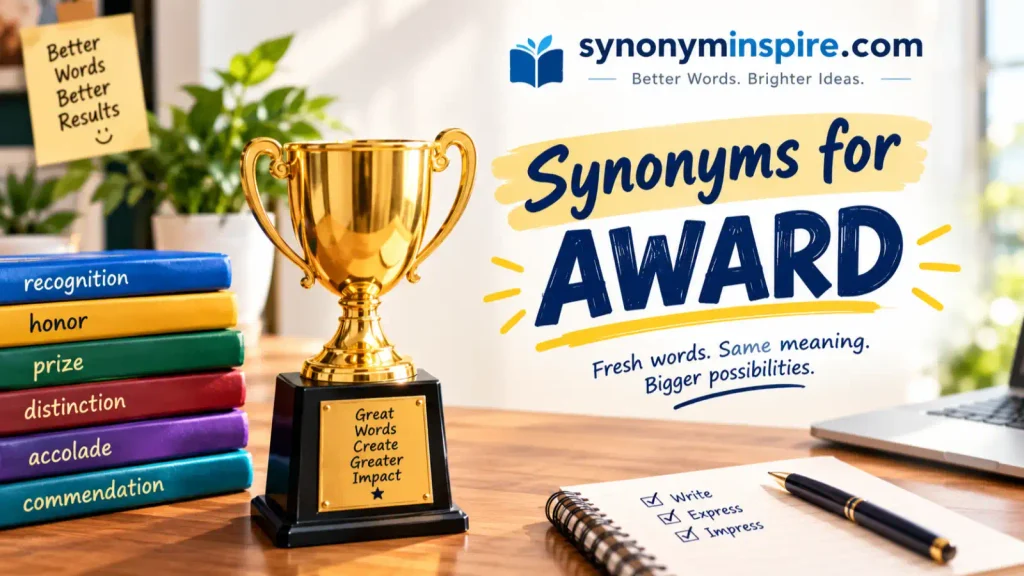
Finding the right alternative to award depends on what you mean. Award can refer to a prize given for achievement, an honor or recognition, or an official decision that grants something. The best substitute therefore changes with context. This guide covers precise synonyms, formal alternatives, professional wording, academic uses, and natural everyday options.
If you are writing an essay, certificate, announcement, business email, or award citation, choosing a more specific word can make the sentence clearer. Some alternatives are true synonyms, while others describe a particular kind of award or the act of giving one.
Quick Answer
Useful synonyms for award include prize, honor, accolade, distinction, recognition, trophy, medal, reward, grant, scholarship, commendation, citation, decoration, distinction, title, certification, and achievement. The right choice depends on whether you mean a prize, public recognition, an official honor, or something formally granted.
Quick List: 37+ Alternatives to Award
Closest alternatives
- Prize — true synonym
- Honor — near synonym
- Accolade — near synonym
- Recognition — near synonym
- Distinction — near synonym
- Commendation — near synonym
- Reward — near synonym
- Trophy — narrower expression
- Medal — narrower expression
- Decoration — narrower/formal expression
Formal alternatives
- Citation
- Distinction
- Commendation
- Decoration
- Honor
- Accolade
- Recognition
- Laurels
- Achievement
- Merit
- Title
- Certification
Neutral alternatives
- Prize
- Reward
- Trophy
- Medal
- Grant
- Scholarship
- Gift
- Recognition
- Achievement
- Honor
Contextual alternatives
- Fellowship
- Appointment
- Promotion
- Grant
- Scholarship
- Certificate
- Plaque
- Mention
- Tribute
- Commendation
Casual alternatives
There are relatively few genuine slang equivalents for award. In casual speech, people may simply say prize, win, trophy, honor, or recognition, depending on the situation.
Formal Alternatives to “Award”
Not every formal alternative has exactly the same meaning. The distinctions below matter if you are writing a report, certificate, recommendation, announcement, or professional document.
1. Accolade
Meaning: An expression or symbol of praise for an achievement.
Classification: Near synonym.
Explanation: Accolade emphasizes praise and recognition rather than the physical prize itself.
Example: The scientist received an international accolade for her research.
Best use: Formal writing, journalism, professional profiles, and biographies.
Worst use: Referring specifically to money or a physical trophy.
Tone: Formal and complimentary.
2. Honor
Meaning: Recognition given because someone has achieved something notable or deserves respect.
Classification: Near synonym.
Example: She received the highest honor from the university.
Best use: Ceremonies, institutions, biographies, and formal announcements.
Worst use: When you specifically mean a competition prize.
Tone: Formal, respectful.
3. Distinction
Meaning: Special recognition for excellence or achievement.
Classification: Near synonym.
Example: He graduated with distinction.
Best use: Academic, professional, and institutional contexts.
Worst use: When the reader expects a physical prize.
Tone: Formal and polished.
4. Commendation
Meaning: Formal praise for good work or conduct.
Classification: Near synonym.
Example: The employee received a commendation for exceptional service.
Best use: Workplace, military, institutional, and official contexts.
Worst use: Informal references to a simple contest prize.
Tone: Formal.
5. Citation
Meaning: An official statement recognizing someone’s achievement or service.
Classification: Contextual alternative.
Example: The firefighter received a citation for bravery.
Best use: Official ceremonies, military settings, professional recognition, and formal records.
Worst use: As a general replacement for every kind of prize.
Tone: Formal and official.
6. Decoration
Meaning: An official medal or honor awarded for notable service or achievement.
Classification: Narrower expression.
Example: The officer received a military decoration.
Best use: Military, government, and historical contexts.
Worst use: Ordinary school or workplace prizes.
Tone: Highly formal.
7. Recognition
Meaning: Acknowledgment of someone’s achievement, contribution, or merit.
Classification: Near synonym.
Example: Her contribution earned recognition from the organization.
Best use: Business writing, professional profiles, and general communication.
Worst use: When a specific physical prize must be identified.
Tone: Neutral to formal.
8. Laurels
Meaning: Honors or praise earned through achievement.
Classification: Contextual alternative.
Example: The athlete returned home with international laurels.
Best use: Literary or elevated writing.
Worst use: Straightforward business emails.
Tone: Formal and literary.
9. Merit
Meaning: A quality deserving praise, recognition, or reward.
Classification: Contextual alternative.
Example: The scholarship was awarded on academic merit.
Best use: Academic and institutional writing.
Worst use: Replacing award when referring to the prize itself.
Tone: Formal.
10. Title
Meaning: A designation given to someone after achieving a particular distinction.
Classification: Narrower expression.
Example: She won the title of national champion.
Best use: Sports, competitions, pageants, and professional distinctions.
Worst use: General awards that do not confer a title.
Tone: Neutral to formal.
11. Certification
Meaning: Official confirmation that someone has met a particular standard or requirement.
Classification: Contextual alternative.
Example: The technician received professional certification.
Best use: Professional and educational settings.
Worst use: Treating a certification as identical to a prize.
Tone: Formal and professional.
12. Tribute
Meaning: An expression of respect, admiration, or appreciation.
Classification: Contextual alternative.
Example: The ceremony was a tribute to her decades of service.
Best use: Retirement events, memorials, ceremonies, and public recognition.
Worst use: A competitive prize where there is a winner.
Tone: Respectful and formal.
Semi-Formal and Neutral Alternatives
13. Prize
Meaning: Something given to a winner in a competition or for achievement.
Classification: True synonym in the competition sense.
Example: Maya won first prize in the writing contest.
Best use: Competitions, contests, school events, and general writing.
Worst use: Formal honors that do not involve competition.
Tone: Neutral.
14. Reward
Meaning: Something given in recognition of good work, behavior, or achievement.
Classification: Near synonym.
Example: The company offered a reward for the best improvement idea.
Best use: General achievement or incentive contexts.
Worst use: Formal honors where honor or distinction is more accurate.
Tone: Neutral.
15. Trophy
Meaning: A physical object given to recognize victory or achievement.
Classification: Narrower expression.
Example: The team lifted the championship trophy.
Best use: Sports and competitions.
Worst use: Referring to a certificate, cash prize, or honorary recognition.
Tone: Neutral.
16. Medal
Meaning: A metal object presented as recognition of achievement.
Classification: Narrower expression.
Example: She received a gold medal for her performance.
Best use: Sports, military, academic, and ceremonial contexts.
Worst use: When no medal is actually involved.
Tone: Neutral to formal.
17. Grant
Meaning: Money or resources formally provided for a particular purpose.
Classification: Contextual/narrower expression.
Example: The researcher received a grant to study coastal ecosystems.
Best use: Research, education, nonprofit work, and public funding.
Worst use: Replacing award when talking about an honor.
Tone: Professional.
18. Scholarship
Meaning: Financial assistance given to support a student’s education.
Classification: Narrower expression.
Example: She received a scholarship for academic excellence.
Best use: Education.
Worst use: Calling every academic prize a scholarship.
Tone: Neutral to formal.
19. Plaque
Meaning: A decorative or commemorative object presented as recognition.
Classification: Narrower expression.
Example: The volunteers were presented with a plaque for their service.
Best use: Workplace, community, and ceremonial recognition.
Worst use: Referring to an award that is monetary or purely honorary.
Tone: Neutral.
20. Certificate
Meaning: A document officially confirming an achievement, qualification, or participation.
Classification: Contextual alternative.
Example: Each participant received a certificate of completion.
Best use: Training, education, workshops, and professional development.
Worst use: Assuming a certificate necessarily represents competitive achievement.
Tone: Neutral and professional.
21. Achievement
Meaning: Something successfully accomplished.
Classification: Broader expression.
Example: Winning the competition was one of her greatest achievements.
Best use: Resumes, biographies, profiles, and general writing.
Worst use: Calling the achievement itself an award.
Tone: Neutral.
22. Fellowship
Meaning: A position or funding opportunity granted to support advanced study, research, or professional development.
Classification: Contextual/narrower expression.
Example: He received a research fellowship at the university.
Best use: Academic and professional settings.
Worst use: General competition prizes.
Tone: Formal.
23. Gift
Meaning: Something given voluntarily to another person.
Classification: Broader expression.
Example: The winner received a gift from the event sponsor.
Best use: Informal contexts where the item is genuinely a gift.
Worst use: Formal award announcements.
Tone: Casual to neutral.
24. Mention
Meaning: Public acknowledgment of someone’s contribution or performance.
Classification: Contextual alternative.
Example: Her essay received an honorable mention.
Best use: Competitions and publications.
Worst use: Describing the first-place winner.
Tone: Neutral.
25. Honorable Mention
Meaning: Recognition given to an entry that deserves praise but did not receive the main prize.
Classification: Narrower expression.
Example: His photograph earned an honorable mention.
Best use: Competitions, contests, and exhibitions.
Worst use: As a synonym for the main award.
Tone: Neutral to formal.
26. Win
Meaning: Success in a competition or contest.
Classification: Casual/contextual alternative.
Example: Her latest win earned her national attention.
Best use: Sports, entertainment, competitions, and casual writing.
Worst use: Formal institutional records where the actual award should be named.
Tone: Casual to neutral.
Informal and Casual Alternatives
Unlike some verbs, award does not have many true slang synonyms. Casual speech usually changes the sentence rather than replacing the word directly.
27. Win
Example: I won a prize at the school fair.
When natural: Talking about competitions.
When to avoid: Formal award citations.
Tone: Casual.
28. Prize
Example: She picked up a prize for her painting.
When natural: Everyday conversation.
When to avoid: Governmental or ceremonial honors that are not prizes.
Tone: Neutral and conversational.
29. Trophy
Example: Our team brought home a trophy.
When natural: Sports and competitions.
When to avoid: Abstract recognition.
Tone: Casual to neutral.
30. Perk
Meaning: An extra benefit or advantage.
Classification: Contextual alternative, not a true synonym.
Example: The employee recognition program came with a small perk.
When natural: Informal workplace conversation.
When to avoid: Formal award descriptions.
Tone: Casual.
True Synonyms vs. Contextual Alternatives
| Type | What It Means | Can It Replace “Award”? |
|---|---|---|
| True synonym | A word with essentially the same meaning in a specific context | Yes, in that context |
| Near synonym | Similar meaning but a different emphasis or scope | Sometimes |
| Contextual alternative | Works naturally in a related situation | Only when the context fits |
| Broader expression | Covers a wider idea than an award | Not always |
| Narrower expression | Refers to one particular type of award | Only for that type |
The safest direct replacement is usually prize when award means something given to a competition winner. Honor, recognition, and accolade work better when the focus is praise or distinction rather than a physical prize.
Business Writing
In business documents, recognition, commendation, achievement, and distinction are often more precise than award.
Instead of:
The company gave Maria an award for excellent customer service.
You could write:
Maria received recognition for her excellent customer service.
If the company gives her a physical prize, however, award or prize may be more direct.
Corporate Communication
Announcements can use recognition, honor, distinction, or commendation depending on the purpose.
The annual report recognizes employees whose contributions had a measurable impact.
This sounds different from:
The annual report lists the winners of the employee awards.
The first emphasizes acknowledgment; the second focuses on formal awards.
Academic Writing
Academic contexts commonly use scholarship, fellowship, grant, distinction, honor, and prize.
For example:
She received a research grant to investigate renewable energy storage.
Calling the grant simply a prize would change the meaning because a grant normally provides funding for a defined purpose.
Customer Service
Customer-facing communication benefits from simple terms such as recognition, compliment, honor, and reward.
Your outstanding service has earned special recognition from our team.
That wording is often clearer than using a highly formal term such as accolade.
Legal and Official Writing
Legal and official documents require extra precision. Award can have a specific technical meaning, including an amount or decision granted by an authority, tribunal, arbitrator, or court.
For example:
The arbitrator awarded damages to the claimant.
Replacing awarded with honored would completely change the meaning.
For legal documents, use the terminology required by the relevant document and jurisdiction rather than choosing a synonym simply for stylistic variety.
Email Communication
For professional emails, recognition, honor, commendation, and prize can each work in different situations.
Congratulations on receiving this year’s leadership award.
Could become:
Congratulations on receiving this year’s leadership honor.
But if the organization officially calls it a Leadership Award, keeping the official name is usually clearer.
8 Email Examples Using Alternatives
Email 1 — Employee Recognition
Subject: Recognition for Outstanding Service
Hi Elena,
I wanted to congratulate you on the recognition you received for your work with the customer support team. Your patience and attention to detail have made a real difference.
Best,
Marcus
Email 2 — Academic Prize
Subject: Congratulations on Your Writing Prize
Hi Jordan,
Congratulations on winning the department’s writing prize. Your essay stood out for its clear argument and thoughtful research.
Best wishes,
Professor Lane
Email 3 — Research Grant
Subject: Research Grant Confirmation
Dear Dr. Patel,
I’m pleased to let you know that your research grant has been approved. The funding will support the next phase of your environmental study.
Regards,
Nina
Email 4 — Professional Commendation
Subject: Commendation for Excellent Work
Hi Andre,
I wanted to formally commend you for the way you handled last week’s client transition. You kept the process organized and communicated clearly throughout.
Thank you,
Rachel
Email 5 — Scholarship
Subject: Scholarship Notification
Dear Taylor,
We are pleased to inform you that you have been selected for this year’s academic scholarship. Congratulations on this achievement.
Sincerely,
The Student Awards Committee
Email 6 — Honorable Mention
Subject: Your Honorable Mention
Hi Sophie,
Congratulations on receiving an honorable mention in the regional photography competition. The judges highlighted the originality of your composition.
Best,
Daniel
Five Short Dialogue Examples
Workplace
Person A: Why is everyone congratulating Nina?
Person B: She received recognition for leading the new training program.
Classroom
Person A: Did you enter the essay contest?
Person B: Yes, and I won first prize.
Customer Service
Person A: Why did the manager contact you?
Person B: She wanted to give me a commendation for helping a customer.
Sports
Person A: What did the team bring home?
Person B: A championship trophy.
Academic
Person A: How will you fund your research?
Person B: I received a fellowship from the university.
How to Replace “Award” in a Sentence
1. General competition
Original: She received an award for her painting.
Alternative: She received a prize for her painting.
Why it works: Prize is a close match when the recognition comes from a competition.
2. Public recognition
Original: He received an award for his community service.
Alternative: He received recognition for his community service.
Why it works: This shifts attention from the object presented to the acknowledgment itself.
3. Formal praise
Original: The employee received an award for outstanding performance.
Alternative: The employee received a commendation for outstanding performance.
Why it works: Commendation highlights formal praise.
4. Academic funding
Original: She received an award to support her research.
Alternative: She received a research grant to support her research.
Why it works: Grant identifies the type of financial support more precisely.
5. Academic achievement
Original: He received an award for academic excellence.
Alternative: He graduated with distinction.
Why it works: The sentence changes from receiving a prize to describing an academic distinction.
6. Sports
Original: The team received an award after winning the tournament.
Alternative: The team received a trophy after winning the tournament.
Why it works: Trophy is appropriate if the physical award was actually a trophy.
7. Official honor
Original: The veteran received an award for his service.
Alternative: The veteran received a decoration for his service.
Why it works: Decoration is more specific when the honor is an official medal or insignia.
8. Competitive success
Original: She received an award in the national competition.
Alternative: She won in the national competition.
Why it works: Won emphasizes the result rather than the award itself.
Comparison: Which Word Fits?
| Phrase | Tone | Meaning / Scope | Best Use | Example |
|---|---|---|---|---|
| Award | Neutral/formal | Something officially given for achievement | General use | She received an award. |
| Prize | Neutral | Recognition for winning or achievement | Competitions | He won first prize. |
| Honor | Formal | Respect or distinction | Ceremonies | She received a great honor. |
| Accolade | Formal | Praise or distinction | Professional/public recognition | He earned an international accolade. |
| Recognition | Neutral/formal | Acknowledgment of merit | Workplace/general | Her work received recognition. |
| Commendation | Formal | Formal praise | Work/service | He received a commendation. |
| Trophy | Neutral | Physical object for achievement | Sports | They lifted the trophy. |
| Medal | Neutral/formal | Physical medal recognizing achievement | Sports/service | She won a gold medal. |
| Grant | Professional | Funding for a purpose | Research/projects | They received a grant. |
| Scholarship | Formal/neutral | Educational financial support | Education | He earned a scholarship. |
| Citation | Formal | Official recognition statement | Service/official contexts | She received a citation. |
| Plaque | Neutral | Physical recognition item | Ceremonies | He received a plaque. |
Which Alternative Should You Choose?
For formal writing: Use accolade, distinction, honor, commendation, recognition, or citation, depending on the exact meaning.
And For business communication: Recognition and commendation are usually clear and professional.
For academic writing: Choose distinction, scholarship, fellowship, grant, or prize according to what was actually given.
For legal writing: Keep award when it has a technical legal meaning. Do not replace it just to avoid repetition.
For professional email: Recognition, honor, commendation, and prize are useful when their meanings fit.
And For everyday conversation: Prize, trophy, win, and award are usually the most natural choices.
For casual messages: A simple phrase such as “I won a prize” often sounds more natural than “I received an accolade.”
Grammar and Usage Guide
“Award” as a noun
As a noun, award refers to something given as recognition.
She received an award for innovation.
The plural is awards:
The ceremony included several awards.
“Award” as a verb
As a verb, award means to officially give something.
The committee awarded him the scholarship.
A common structure is:
award + person + thing
The judges awarded Priya first prize.
Another common construction is:
award + thing + to + person
The judges awarded first prize to Priya.
“Award” vs. “reward”
These words are related but not identical.
An award is generally formal recognition of achievement.
A reward is something given because of an action, result, behavior, or service and may also be an incentive.
She received an award for her research.
The company offered a reward for information.
“Award” vs. “prize”
A prize is especially common for competitions.
He won the first prize.
Award is broader and can cover honors, recognition, and formal distinctions that are not necessarily competitive.
“Award” vs. “honor”
An honor emphasizes respect or distinction.
Receiving the award was a great honor.
Notice that the two words can appear in the same sentence because they do not always mean exactly the same thing.
Common collocations
Natural combinations include:
- receive an award
- win an award
- present an award
- give an award
- earn an award
- prestigious award
- international award
- annual award
- award ceremony
- award winner
- award recipient
- award-winning
- award for excellence
Common Mistakes to Avoid
Treating every alternative as identical
Prize, honor, grant, and trophy describe different things. Choose based on the actual situation.
Using “accolade” for money
An accolade is recognition or praise, not normally a monetary payment.
Calling a grant a prize
A grant provides funding for a defined purpose. It is not necessarily a competition prize.
Using “trophy” for abstract recognition
A trophy is normally a physical object. If someone receives only public acknowledgment, recognition is better.
Overusing formal vocabulary
Words such as accolade and laurels can sound unnatural in ordinary conversation.
Replacing official names
If an organization officially calls something the Excellence Award, changing the name to Excellence Honor can create confusion.
Ignoring technical meaning
In legal or official contexts, award may have a specialized meaning. A general synonym may not preserve that meaning.
Confusing achievement with award
An achievement is something accomplished. An award is recognition given for an accomplishment.
When “Award” Is Actually the Best Choice
You should keep award rather than searching for a substitute when:
- You are using the official name of a prize or honor.
- You are describing an award ceremony.
- You need a broad term covering different kinds of recognition.
- You are writing about a formal decision to grant money or damages.
- The exact type of recognition is not important.
- You are describing an established phrase such as “award-winning.”
- Replacing the word would make the sentence less precise.
For example, award-winning author is usually more natural than trying to replace award with recognition-winning author.
Advanced Tips for Choosing the Right Word
Match the word to the object
If the person receives a medal, say medal. If they receive research funding, say grant. Specific language is stronger than a vague synonym.
Match the register
A formal biography may comfortably use accolade. A text message probably should not.
Preserve the original meaning
Before replacing award, ask what the word is doing:
- Is it naming a prize?
- Describing public recognition?
- Identifying funding?
- Referring to a physical object?
- Describing an official decision?
The answer determines the best alternative.
Avoid synonym hunting for its own sake
Repeating award is not automatically a writing problem. If it is the most accurate word, use it.
Use official terminology consistently
Certificates, grants, scholarships, titles, and honors often have established names. Consistency matters more than stylistic variation.
Related Questions About “Award”
What is another way to say “award”?
Depending on the context, you can say prize, honor, accolade, recognition, distinction, commendation, reward, trophy, medal, citation, or decoration. These are not all interchangeable, so the specific type of recognition should guide your choice.
What is a professional alternative to “award”?
Recognition, distinction, commendation, and accolade are useful professional alternatives. Recognition is particularly flexible because it can describe acknowledgment without implying a specific physical prize.
Is “award” a formal word?
Award is both neutral and formal enough for professional writing. It is common in everyday English as well as business, academic, institutional, and legal contexts. Its register depends partly on how it is used.
What is the difference between “award” and “prize”?
A prize commonly refers to something given to a winner in a competition. Award has a broader meaning and can include prizes, honors, distinctions, and other forms of formal recognition.
FAQs:
What is the closest synonym for award?
Prize is one of the closest synonyms when award means something given to a winner. In other contexts, honor, recognition, or accolade may be closer because they emphasize distinction rather than competition.
What is a formal word for award?
Accolade, distinction, commendation, citation, decoration, and honor can serve as formal alternatives. The most accurate choice depends on what kind of recognition was given.
Can “recognition” replace “award”?
Yes, when the focus is acknowledgment of someone’s achievement rather than a specific prize. For example, “She received recognition for her research” does not necessarily mean she received a physical award.
Is “reward” the same as “award”?
No. They overlap, but reward often refers to something given for an action, behavior, result, or service, while award commonly refers to formal recognition of achievement.
What is another word for an award in sports?
Depending on the situation, trophy, medal, prize, title, or honor may be appropriate. A trophy and medal are physical forms of recognition, while a title refers to a championship or designation.
What is the difference between an award and a distinction?
An award is something given to recognize achievement, while a distinction is a mark of excellence or special recognition. Academic institutions commonly use distinction to describe a level of achievement.
Can “accolade” be used for every award?
No. Accolade emphasizes praise or recognition and is often used for notable achievements. It is not the most precise replacement when you need to identify a specific scholarship, grant, medal, or monetary prize.
Key Takeaways
- Prize is one of the closest alternatives when an award comes from a competition.
- Recognition, honor, accolade, and distinction emphasize praise or status rather than the physical prize.
- Trophy, medal, scholarship, grant, and fellowship are narrower terms and should only be used when they accurately describe what was given.
- In professional and academic writing, specificity is usually more useful than simply replacing award with a more sophisticated word.
- Keep award when it is the official name, the clearest general term, or a technical term whose meaning would change with a synonym.
Conclusion:
The best synonym for award depends on what the original word means in your sentence. Prize works naturally for competitions, while recognition, honor, accolade, and distinction are better when the focus is praise or achievement. More specific words such as medal, trophy, scholarship, grant, fellowship, citation, and decoration can make writing more precise, but they should only be used when they describe the actual form of recognition.
For professional writing, clarity should come before variety. If award is already the most accurate word, there is no need to replace it. When you do need an alternative, consider the audience, tone, purpose, and exact type of recognition. A precise word will almost always sound more natural than a forced synonym.

Irene Strong is a passionate language writer and vocabulary enthusiast at SynonymInspire. She creates clear, useful, and engaging content on synonyms, word meanings, and English vocabulary to help readers find the right words with confidence.