
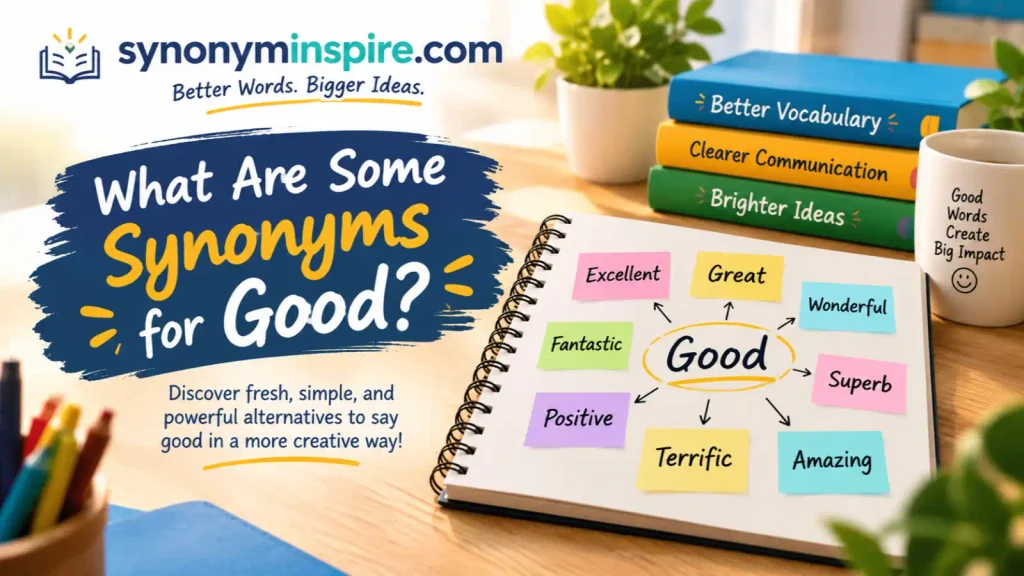
The word good is useful, friendly, and easy to understand, but using it repeatedly can make your writing feel plain. Finding the right synonym for good helps you describe quality, express approval, strengthen an argument, or communicate professionally without changing your intended meaning.
The best alternative depends on what you want to say. A good presentation might be excellent, a good employee might be reliable, and a good decision might be wise. These words share a positive meaning, but each highlights a different quality. Below, you’ll find more than 40 alternatives, examples, formal and casual choices, and practical advice for using them naturally in essays, emails, reports, and everyday conversations.
Quick Answer
Synonyms for good include excellent, great, fine, positive, beneficial, effective, valuable, helpful, admirable, satisfactory, impressive, favorable, outstanding, enjoyable, and worthwhile. The best choice depends on context: use excellent for high quality, beneficial for positive effects, effective for successful results, and satisfactory when something meets expectations.
40+ Alternatives to Good
Here is a quick list of useful alternatives, grouped by meaning and tone.
Closest alternatives
- Great
- Excellent
- Fine
- Wonderful
- Positive
- Pleasant
- First-rate
- Superb
- Admirable
- Outstanding
Formal and professional alternatives
- Beneficial
- Effective
- Favorable
- Valuable
- Desirable
- Meritorious
- Commendable
- Exemplary
- Advantageous
- Satisfactory
Neutral and everyday alternatives
- Helpful
- Useful
- Reliable
- Suitable
- Appropriate
- Enjoyable
- Worthwhile
- Quality
- Impressive
- Successful
Casual alternatives
- Awesome
- Amazing
- Cool
- Solid
- Terrific
- Fantastic
- Brilliant
- Neat
Context-specific alternatives
- Wise — for a sensible decision
- Ethical — for morally acceptable behavior
- Healthy — for physical well-being
- Skilled — for a capable person
- Tasty — for food with a pleasant flavor
- Kind — for considerate behavior
- Safe — for freedom from danger
- Accurate — for correct information
- Generous — for giving freely
- Sincere — for genuine feelings or intentions
These words are not all interchangeable. For example, accurate describes correctness, while kind describes behavior toward others. Both can express a positive quality, but they communicate different ideas.
Formal Synonyms for Good
Formal writing often benefits from precise words rather than general praise. These alternatives work well in business reports, academic assignments, professional correspondence, and evaluations.
Excellent
Meaning: Exceptionally high in quality.
Explanation: A stronger alternative to good when something performs or compares very well. It suggests more than basic acceptability.
Example: The research team produced an excellent analysis of the results.
Best Use: Evaluations, reports, presentations, and recommendations.
Worst Use: Describing something that merely meets minimum requirements.
Tone: Confident and professional.
Beneficial
Meaning: Producing a helpful or positive effect.
Explanation: This is a contextual alternative, not a universal synonym. It emphasizes the advantages something provides.
Example: Regular feedback is beneficial to employee development.
Best Use: Academic writing, workplace policies, and discussions of outcomes.
Worst Use: Describing an attractive object or a pleasant meal.
Tone: Formal and analytical.
Effective
Meaning: Producing the intended result.
Explanation: Use it when a method, plan, or tool works successfully. Something can be effective without being enjoyable or impressive.
Example: The revised training program was effective in reducing errors.
Best Use: Business reports, research, and performance reviews.
Worst Use: Praising a person simply for being kind or likable.
Tone: Objective and professional.
Favorable
Meaning: Positive, supportive, or likely to lead to a good outcome.
Explanation: This word often describes conditions, opinions, results, or circumstances.
Example: The company received favorable feedback from its customers.
Best Use: Reports, evaluations, and business updates.
Worst Use: Casual praise such as describing a delicious dessert.
Tone: Formal and measured.
Valuable
Meaning: Worth a great deal because of its usefulness, importance, or quality.
Explanation: It emphasizes importance or worth rather than general positivity.
Example: Her feedback provided valuable insight into the problem.
Best Use: Professional communication, education, and project reviews.
Worst Use: When you only mean that something is inexpensive or easy to obtain.
Tone: Respectful and professional.
Desirable
Meaning: Worth wanting or considered a positive outcome.
Explanation: A good choice when discussing goals, qualities, or preferred results.
Example: Clear communication is a desirable skill for team leaders.
Best Use: Policies, formal recommendations, and planning.
Worst Use: Everyday praise where a simpler word sounds more natural.
Tone: Formal and evaluative.
Commendable
Meaning: Deserving praise or approval.
Explanation: This word focuses on an action or achievement that deserves recognition.
Example: Her commitment to helping new students was commendable.
Best Use: Performance reviews, award nominations, and formal recognition.
Worst Use: Describing a product that simply works as expected.
Tone: Respectful and appreciative.
Exemplary
Meaning: Serving as an excellent example for others.
Explanation: Stronger and more specific than good. It suggests behavior or performance that others could follow.
Example: The supervisor demonstrated exemplary leadership during the transition.
Best Use: Academic evaluations, leadership reviews, and formal commendations.
Worst Use: Ordinary situations that do not justify exceptional praise.
Tone: Highly positive and formal.
Meritorious
Meaning: Deserving recognition because of merit or achievement.
Explanation: This formal alternative emphasizes the worthiness of an action, contribution, or accomplishment.
Example: The committee recognized her meritorious service to the community.
Best Use: Awards, formal assessments, and institutional writing.
Worst Use: Casual conversation or simple customer feedback.
Tone: Very formal.
Satisfactory
Meaning: Meeting the required standard or expectation.
Explanation: Unlike excellent, this word usually indicates acceptability rather than outstanding quality.
Example: The submitted report was satisfactory and met all required criteria.
Best Use: Assessments, inspections, and performance reports.
Worst Use: When you want to express strong enthusiasm.
Tone: Neutral to formal.
Advantageous
Meaning: Providing a benefit or creating a favorable position.
Explanation: This word describes something that gives a person, group, or organization an advantage.
Example: Flexible scheduling can be advantageous for working parents.
Best Use: Business decisions, planning, and formal comparisons.
Worst Use: Describing an ordinary object without reference to its benefits.
Tone: Analytical and professional.
Outstanding
Meaning: Exceptionally good or noticeably superior.
Explanation: This word communicates a high level of quality or achievement.
Example: The designer delivered outstanding work on the campaign.
Best Use: Recommendations, evaluations, and achievement summaries.
Worst Use: Situations where a modest or neutral assessment is more accurate.
Tone: Strongly positive.
Neutral and Everyday Alternatives
Neutral words are especially useful when you want natural writing without sounding overly formal or enthusiastic.
Great
Meaning: Very good or impressive.
Explanation: A versatile near synonym that works in many everyday situations.
Example: We had a great discussion about the new project.
Best Use: Conversations, friendly emails, and general feedback.
Worst Use: Highly technical reports that require precise evaluation.
Tone: Friendly and positive.
Helpful
Meaning: Providing assistance or making something easier.
Explanation: It focuses on the support something offers rather than its overall quality.
Example: The instructions were helpful when I installed the software.
Best Use: Customer service, tutorials, reviews, and communication.
Worst Use: Praising something that offers no actual assistance.
Tone: Warm and practical.
Useful
Meaning: Serving a practical purpose.
Explanation: A good alternative when an object, idea, or resource helps accomplish a task.
Example: The checklist is useful for preparing the monthly report.
Best Use: Guides, educational writing, and workplace communication.
Worst Use: Describing something enjoyable when practical value is not the point.
Tone: Neutral and direct.
Reliable
Meaning: Consistently dependable.
Explanation: This word describes trustworthiness or consistent performance, not every aspect of quality.
Example: We need a reliable supplier who can deliver materials on time.
Best Use: Recommendations, product reviews, and professional evaluations.
Worst Use: Describing a single successful result without evidence of consistency.
Tone: Practical and confident.
Suitable
Meaning: Appropriate for a particular purpose.
Explanation: Use it when something meets the needs of a situation.
Example: This room is suitable for a small training session.
Best Use: Planning, instructions, and recommendations.
Worst Use: Expressing strong excitement or admiration.
Tone: Neutral and measured.
Appropriate
Meaning: Proper or fitting for the circumstances.
Explanation: Similar to suitable, but often emphasizes social rules, professional standards, or the needs of a situation.
Example: Please use appropriate language when addressing customers.
Best Use: Policies, emails, academic writing, and professional guidance.
Worst Use: Describing something exceptionally impressive.
Tone: Professional and restrained.
Positive
Meaning: Favorable, constructive, or encouraging.
Explanation: It often describes attitudes, feedback, developments, or results.
Example: The interview panel gave positive feedback about her presentation.
Best Use: Progress reports, evaluations, and discussions of outcomes.
Worst Use: When a precise measure of quality is needed.
Tone: Encouraging and neutral.
Pleasant
Meaning: Enjoyable or agreeable.
Explanation: This word describes an experience, atmosphere, interaction, or sensation that feels nice.
Example: The team enjoyed a pleasant afternoon at the park.
Best Use: Personal descriptions, reviews, and everyday writing.
Worst Use: Describing a method that must be proven effective.
Tone: Gentle and friendly.
Worthwhile
Meaning: Worth the time, effort, or cost involved.
Explanation: It evaluates whether an activity or investment provides enough value to justify the resources used.
Example: Completing the extra practice exercises was worthwhile.
Best Use: Reviews, recommendations, education, and planning.
Worst Use: Describing a pleasant color or taste without discussing value.
Tone: Thoughtful and positive.
Enjoyable
Meaning: Giving pleasure or satisfaction.
Explanation: This word focuses on the experience of doing or receiving something.
Example: The workshop was enjoyable and gave everyone a chance to participate.
Best Use: Events, activities, entertainment, and personal reviews.
Worst Use: Evaluating technical accuracy or professional competence.
Tone: Friendly and positive.
Impressive
Meaning: Causing admiration because of quality, scale, or achievement.
Explanation: It highlights a noticeable strength that stands out to an observer.
Example: The student gave an impressive presentation despite having limited preparation time.
Best Use: Reviews, feedback, and descriptions of achievements.
Worst Use: When the only requirement is that something meets a basic standard.
Tone: Appreciative.
Casual Words for Good
Informal alternatives can make conversation and messages sound more natural. Their suitability depends on your audience and setting.
Awesome
Meaning: Extremely good or exciting.
Example: That was an awesome performance!
When natural: Text messages, friendly conversations, and informal reviews.
When to avoid: Formal reports or serious evaluations.
Tone: Enthusiastic and casual.
Amazing
Meaning: Extremely impressive or surprising.
Example: Your photos from the trip look amazing.
When natural: Compliments, personal messages, and social media.
When to avoid: Neutral assessments that should not exaggerate the result.
Tone: Expressive and upbeat.
Cool
Meaning: Good, interesting, or appealing in an informal sense.
Example: That’s a cool idea for the school project.
When natural: Conversations with friends and relaxed workplace chats.
When to avoid: Formal correspondence or detailed professional assessments.
Tone: Relaxed and conversational.
Solid
Meaning: Dependable, respectable, or reasonably strong.
Example: She made a solid argument in favor of the proposal.
When natural: Informal feedback, discussions, and reviews.
When to avoid: Situations requiring a clear distinction between acceptable and exceptional performance.
Tone: Casual but often understated.
Fantastic
Meaning: Extremely good or enjoyable.
Example: We had a fantastic time at the festival.
When natural: Friendly messages, celebrations, and enthusiastic reviews.
When to avoid: Formal documents that require restrained language.
Tone: Energetic and positive.
Brilliant
Meaning: Exceptionally clever, impressive, or excellent.
Example: That was a brilliant solution to the scheduling problem.
When natural: Informal praise, especially for ideas or achievements. It is common in British English and also understood in American English.
When to avoid: When you mean merely acceptable rather than exceptional.
Tone: Enthusiastic and appreciative.
True Synonyms vs. Contextual Alternatives
Not every positive word carries the same meaning. This distinction helps you select an alternative without accidentally changing your message.
| Type | What It Means | Can It Replace Good? |
|---|---|---|
| True synonym | A word with a very similar meaning in the relevant sentence, such as great in many everyday contexts | Usually, if the sentence still sounds natural |
| Near synonym | A word with a related but slightly different meaning, such as excellent | Yes, when the stronger meaning fits |
| Contextual alternative | A word suited to a specific situation, such as effective for a method | Only when that specific meaning is intended |
| Broader expression | A phrase covering a wider idea, such as high quality | Sometimes, with sentence adjustments |
| Narrower expression | A word describing one specific quality, such as accurate | Only when correctness is the intended meaning |
For example, “This is a good plan” could become “This is a practical plan,” but the emphasis changes. Good expresses general approval, while practical suggests that the plan can work in real circumstances.
Synonyms in Professional and Academic Writing
The best alternative often depends on the type of document you are preparing.
Business writing
Business communication benefits from words that explain the value of a decision or action.
- “We developed a cost-effective approach to managing expenses.”
- “The team proposed a practical solution to the delivery problem.”
- “The new process produced measurable improvements.”
These alternatives are more informative than saying an approach or process is good. However, use cost-effective only when the relationship between cost and results supports that description.
Corporate communication
Reports, policies, and announcements often require neutral language.
Instead of “We had good results,” consider:
- “We achieved positive results.”
- “The initiative delivered measurable improvements.”
- “The project met its performance targets.”
The last two expressions are more specific. Use them only when the available results support the claim.
Academic writing
In essays and research papers, choose words that explain what you mean rather than simply expressing approval.
- Good evidence → strong evidence, if the evidence supports the claim.
- Good argument → convincing argument, if the reasoning persuades the reader.
- Good outcome → favorable outcome, when the result is positive.
- Good method → effective method, when it achieves the intended purpose.
- Good source → credible source, when its reliability is established.
Avoid replacing every instance of good with a more sophisticated word. A simple word is often clearer than an elaborate alternative.
Customer service
Customer communication should be clear, polite, and specific.
- “We’re happy to offer a suitable replacement.”
- “Thank you for your helpful feedback.”
- “We’re pleased that the solution was effective.”
These expressions tell customers more than a general statement such as “That’s good.”
Legal writing
Legal documents require precise terminology. Words such as valid, lawful, reasonable, and compliant have specific implications and are not general synonyms for good.
For example, a good agreement is not necessarily a legally valid agreement. Legal validity depends on the applicable law and circumstances. Do not substitute a more specific legal term unless its meaning is supported.
Email communication
Choose the alternative that matches your purpose:
- Praise: “You did excellent work on the presentation.”
- Appreciation: “Your feedback was valuable.”
- Confirmation: “The proposed time is suitable.”
- Progress: “We have made positive progress.”
- Approval: “That is a practical approach.”
Specific praise usually sounds more sincere because it tells the recipient what they did well.
Email Examples Using Alternatives to Good
These examples show how to replace a general word with a more precise expression in realistic professional situations.
Email 1: Praising a presentation
EmailFeedback on Your Presentation
Feedback on Your Presentation
Hi Maya,
Your presentation was excellent. The main points were easy to follow, and the examples helped explain the proposal clearly.
Thank you for putting so much care into the preparation.
Best,
Daniel
Email 2: Sharing a useful resource
EmailResource for the Training Session
Resource for the Training Session
Hello Chris,
I found a helpful guide that explains the new reporting process step by step. I’ve attached it so you can review it before Thursday’s session.
I hope it makes the preparation easier.
Best regards,
Nina
Email 3: Recommending a solution
EmailSuggested Approach for the Project
Suggested Approach for the Project
Hi Jordan,
I think the proposed schedule is practical because it gives the team enough time to review the draft before the final submission.
Let’s discuss any adjustments at tomorrow’s meeting.
Thanks,
Riley
Email 4: Thanking a colleague
EmailThank You for Your Feedback
Thank You for Your Feedback
Hi Sam,
Your feedback was valuable, especially your suggestion to simplify the opening section. I’ve made that change and revised the examples.
Thanks for taking the time to review the document.
Best,
Morgan
Email 5: Confirming an arrangement
EmailConfirmation of Meeting Time
Confirmation of Meeting Time
Hello Taylor,
The proposed meeting time works well for me. Tuesday at 10 a.m. is suitable, and I’ll bring the updated project notes.
Please let me know if anything changes.
Regards,
Casey
Email 6: Recognizing a team achievement
EmailCongratulations on the Project Milestone
Congratulations on the Project Milestone
Hi Team,
Congratulations on reaching the project milestone. Your coordination and attention to detail were impressive, and the final review went smoothly.
Thank you for the effort you put into this work.
Best,
Alex
Short Dialogue Examples
Workplace
Person A: How did the new training session go?
Person B: It was excellent. Everyone understood the process by the end.
Classroom
Person A: What do you think of my essay?
Person B: Your argument is convincing, especially the section with the historical examples.
Customer service
Person A: Did the replacement solve the problem?
Person B: Yes, it works perfectly now. Thank you for your help.
Casual conversation
Person A: How was the concert last night?
Person B: Fantastic! The band sounded even better live.
Professional discussion
Person A: Should we use the proposed approach?
Person B: It seems practical, but let’s review the costs before deciding.
Sentence Transformations
Here are eight ways to replace good with a more precise word or phrase.
Example 1: A general compliment
Original: She gave a good presentation.
Alternative: She gave an impressive presentation.
Why it works: Impressive suggests that the presentation stood out. It is stronger than the original wording.
Example 2: A research method
Original: This is a good method for collecting data.
Alternative: This is an effective method for collecting data.
Why it works: Effective indicates that the method achieves its intended purpose. Use it when the results support that claim.
Example 3: A helpful action
Original: Your advice was good.
Alternative: Your advice was valuable.
Why it works: Valuable emphasizes the importance or usefulness of the advice.
Example 4: A meal
Original: We had good food at the restaurant.
Alternative: We had delicious food at the restaurant.
Why it works: Delicious specifically describes enjoyable flavor, making the sentence more vivid.
Example 5: A decision
Original: That was a good decision.
Alternative: That was a wise decision.
Why it works: Wise emphasizes sound judgment rather than general approval.
Example 6: An employee
Original: She is a good employee.
Alternative: She is a reliable employee.
Why it works: Reliable highlights dependability. It does not automatically mean the employee excels in every other area.
Example 7: A result
Original: The company achieved good results.
Alternative: The company achieved favorable results.
Why it works: Favorable indicates that the results were positive. If you have specific performance figures, including them may be even clearer.
Example 8: A learning experience
Original: The workshop was good.
Alternative: The workshop was worthwhile.
Why it works: Worthwhile suggests that the time and effort spent on the workshop were justified.
Example 9: A suggestion
Original: He made a good suggestion.
Alternative: He made a practical suggestion.
Why it works: Practical indicates that the suggestion could be applied successfully.
Example 10: A person’s behavior
Original: She is a good person.
Alternative: She is a kind and considerate person.
Why it works: The revised sentence explains which qualities make the person admirable rather than relying on a broad judgment.
Comparison Table of Synonyms for Good
| Phrase | Tone | Meaning / Scope | Best Use | Example |
|---|---|---|---|---|
| Excellent | Strongly positive | Very high quality | Reviews, reports | Excellent service |
| Beneficial | Formal | Produces a positive effect | Academic writing | Beneficial changes |
| Effective | Professional | Achieves a result | Methods, plans | Effective strategy |
| Favorable | Formal | Positive or supportive | Results, conditions | Favorable outcome |
| Valuable | Professional | Important or useful | Feedback, resources | Valuable advice |
| Satisfactory | Neutral | Meets requirements | Assessments | Satisfactory performance |
| Reliable | Neutral | Dependable over time | People, products | Reliable supplier |
| Suitable | Neutral | Fits a purpose | Choices, arrangements | Suitable location |
| Enjoyable | Friendly | Provides pleasure | Activities, events | Enjoyable experience |
| Wise | Reflective | Shows good judgment | Decisions, advice | Wise choice |
| Kind | Warm | Shows consideration | Behavior, people | Kind gesture |
| Awesome | Casual | Extremely good | Friendly messages | Awesome concert |
| Solid | Casual | Dependable or respectable | Informal feedback | Solid performance |
| Delicious | Descriptive | Pleasant in taste | Food | Delicious meal |
| Accurate | Precise | Correct or free from errors | Facts, information | Accurate report |
How to Choose the Right Alternative
Use this simple decision guide to match the word to your audience and purpose.
- Formal writing: Choose excellent, beneficial, advantageous, or commendable, depending on the intended meaning.
- Business communication: Prefer effective, practical, reliable, or valuable when these words accurately describe the situation.
- Academic writing: Use convincing, credible, significant, or effective when you can justify the specific claim.
- Legal writing: Select the exact term required by the document’s meaning. Do not use valid or lawful merely as polished alternatives to good.
- Professional email: Use helpful, valuable, suitable, or excellent to communicate clearly and respectfully.
- Everyday conversation: Great, nice, wonderful, and fantastic are natural choices.
- Casual messages: Awesome, cool, and solid work when an informal tone fits your relationship with the reader.
A useful test is to ask yourself: What exactly makes this thing good? If it works well, consider effective. And If it helps someone, try helpful. If it meets a need, use suitable. If it deserves admiration, excellent or commendable may be more accurate.
Grammar and Usage Guide
Understand the word’s role in the sentence
Good is usually an adjective.
- Correct: She is a good teacher.
- Correct: The team produced excellent work.
When you want to describe an action, you may need an adverb instead.
- Adjective: She is a good writer.
- Adverb: She writes well.
In the second sentence, well describes how she writes. Replacing it with good would usually be incorrect in standard English.
Match adjectives with the right nouns
Some alternatives sound natural with particular nouns:
- Effective strategy, treatment, or method
- Delicious meal, dessert, or dish
- Reliable service, supplier, or system
- Credible source, explanation, or claim
- Wise decision, choice, or investment
- Pleasant experience, atmosphere, or conversation
These combinations are common patterns, not rigid rules. The best choice still depends on the intended meaning.
Use comparative and superlative forms correctly
Some alternatives form comparisons with -er and -est:
- Nice → nicer → nicest
- Great → greater → greatest
Others usually use more and most:
- Effective → more effective → most effective
- Beneficial → more beneficial → most beneficial
- Reliable → more reliable → most reliable
Avoid double comparisons such as “more better” or “most excellent” when they do not fit the intended meaning.
Avoid unnecessary intensifiers
Instead of writing “very excellent,” choose a word that already expresses the right level of praise, such as outstanding or exceptional.
However, combinations such as “very helpful” and “highly effective” are natural because those adjectives can take intensifiers.
Keep the sentence structure natural
Not every adjective can replace good in the same grammatical position without changing the meaning.
- Natural: The proposal is beneficial to the community.
- Natural: The proposal benefits the community.
- Awkward: The proposal is benefit to the community.
Also pay attention to prepositions. You can say beneficial to the community, suitable for the role, and effective in reducing waste.
Common Mistakes to Avoid
Using a stronger word than the evidence supports. Calling a satisfactory result outstanding exaggerates its quality.
Treating all positive words as exact synonyms. Accurate means correct, while pleasant means enjoyable. They describe different qualities.
Choosing formal language for a casual setting. Saying “Your contribution was meritorious” to a friend may sound unnatural. “That was really helpful” is usually better.
Using vague praise in professional reports. Instead of “The results were good,” explain what improved or which target was achieved.
Repeating the same adjective. If a paragraph uses good several times, replace only the repetitions that can be improved meaningfully.
Confusing adjectives and adverbs. Say “She performed well,” not “She performed good,” in standard formal English.
Overusing impressive-sounding words. Words such as exemplary and meritorious should be reserved for situations that justify their stronger or more formal tone.
Ignoring the audience. A word that sounds friendly in a text message may sound vague or overly enthusiastic in a formal report.
When Not to Use Good
Although alternatives can improve writing, there are situations where good is still the best choice.
- Simple everyday communication: “Have a good day” is natural and polite. A more elaborate replacement may sound forced.
- Established expressions: Phrases such as “good morning,” “good luck,” and “good idea” are widely understood and often need no change.
- Beginner-friendly explanations: Simple vocabulary helps readers understand information without unnecessary effort.
- When the meaning is intentionally broad: If you are expressing general approval without specifying a particular quality, good may communicate exactly what you intend.
- When precision would be misleading: Calling something effective implies that it achieves a result. If you do not know whether it works, a more cautious expression may be appropriate.
- When a replacement changes the claim: Describing a person as successful does not necessarily mean that the person is kind, ethical, or dependable.
The aim is not to eliminate good from your vocabulary. It is to use it when it fits and choose a more precise word when precision helps the reader.
Advanced Tips for Stronger Word Choice
Describe the quality, not just your opinion
Compare “The book is good” with “The book offers clear explanations and useful examples.” The second sentence tells the reader why the book is worth reading.
Match enthusiasm to the situation
Use excellent for strong praise, satisfactory for meeting expectations, and acceptable when something meets a basic standard. These words communicate different levels of approval.
Be specific in professional emails
Instead of “Good work,” write “Your revised report makes the budget changes much easier to understand.” Specific feedback feels more sincere and gives the recipient useful information.
Choose accuracy over variety
Avoid replacing a word just to make every sentence sound different. If good is the clearest option, keep it. A precise, familiar word is better than an impressive but inaccurate one.
Read the sentence aloud
If an alternative sounds unnatural in ordinary speech, reconsider it. Natural phrasing usually matters more than using an advanced vocabulary word.
Related Questions About Alternatives to Good
What is another way to say good?
Another way to say good is great, excellent, helpful, valuable, effective, or positive. The best choice depends on the sentence. Use excellent for high quality, helpful for assistance, and effective for something that achieves its intended purpose.
What is a professional alternative to good?
Professional alternatives include effective, valuable, reliable, suitable, beneficial, and commendable. For example, “The team developed an effective solution” is more specific than “The team developed a good solution.”
What is a formal word for good in an essay?
Useful formal words include beneficial, advantageous, favorable, effective, and commendable. Choose the word that matches your evidence. For instance, beneficial describes a positive effect, while effective indicates that a method achieves its purpose.
Is good a formal or informal word?
Good is a standard English word suitable for both formal and informal communication. It is not inherently unprofessional. However, a more specific alternative can improve clarity in academic papers, evaluations, and business reports.
What is the difference between good and excellent?
Good expresses general approval or satisfactory quality, while excellent indicates a much higher standard. A good presentation may meet expectations; an excellent presentation usually stands out for its quality, clarity, or impact.
FAQs:
What is the strongest synonym for good?
Outstanding, exceptional, and superb are strong alternatives when something is exceptionally good. They convey more enthusiasm than fine or satisfactory. Choose one only when the level of quality justifies such strong praise.
What word can replace good in a resume?
Words such as skilled, proficient, accomplished, and effective can be useful on a resume, depending on the claim. For example, “good at organizing projects” could become “skilled in project coordination.” Use wording that accurately reflects your experience.
What is a synonym for good that means morally right?
Ethical, virtuous, and honorable can describe morally acceptable behavior or character. They are contextual alternatives, not general replacements for good. For example, an ethical decision follows moral principles, while a good decision might simply be practical or effective.
What is another word for good quality?
High-quality, excellent, superior, and well-made can describe quality, depending on the subject. Use well-made for craftsmanship, superior for a comparison, and excellent for a strong overall assessment.
What is a synonym for good that means useful?
Helpful, beneficial, and valuable are suitable choices when you mean that something provides assistance or value. Useful is often the most direct alternative when something serves a practical purpose.
What is a better word than good for positive results?
Favorable, successful, and promising may work, but each has a different meaning. Favorable means positive, successful indicates that a goal was achieved, and promising suggests that future results may be positive.
Can I use great instead of good in formal writing?
Yes, great is acceptable in many formal contexts, but it can sound conversational or vague in analytical writing. In a research paper or business report, effective, significant, or valuable may communicate the intended meaning more precisely.
Key Takeaways
- Choose a synonym based on the quality you want to describe, not simply because you want to avoid repetition.
- Use excellent for exceptional quality, effective for results, and beneficial for positive effects.
- Keep good when it is natural, clear, and appropriate for your audience.
- In academic and professional writing, support specific claims with evidence rather than relying on stronger adjectives.
- Remember that positive words can carry different meanings, levels of enthusiasm, and degrees of certainty.
Conclusion:
Finding the right synonym for good can make your writing clearer, more expressive, and more appropriate for your audience. Words such as excellent, outstanding, and superb communicate high quality, while helpful, beneficial, and valuable emphasize usefulness. For professional communication, effective, reliable, and suitable often provide more precise descriptions than a general adjective.
The most important step is to understand what you want to communicate. Are you praising someone’s performance, describing a practical solution, evaluating research, or sharing a pleasant experience? Each situation calls for a different word. A reliable employee is dependable, an effective strategy achieves results, and a wise decision reflects sound judgment.
You do not need to replace every occurrence of good. The word remains useful in everyday speech and familiar expressions. Instead, use alternatives when they add meaning, improve accuracy, or help your reader understand your point. That approach builds a stronger vocabulary without making your writing sound forced or unnecessarily complicated.

Irene Strong is a passionate language writer and vocabulary enthusiast at SynonymInspire. She creates clear, useful, and engaging content on synonyms, word meanings, and English vocabulary to help readers find the right words with confidence.