
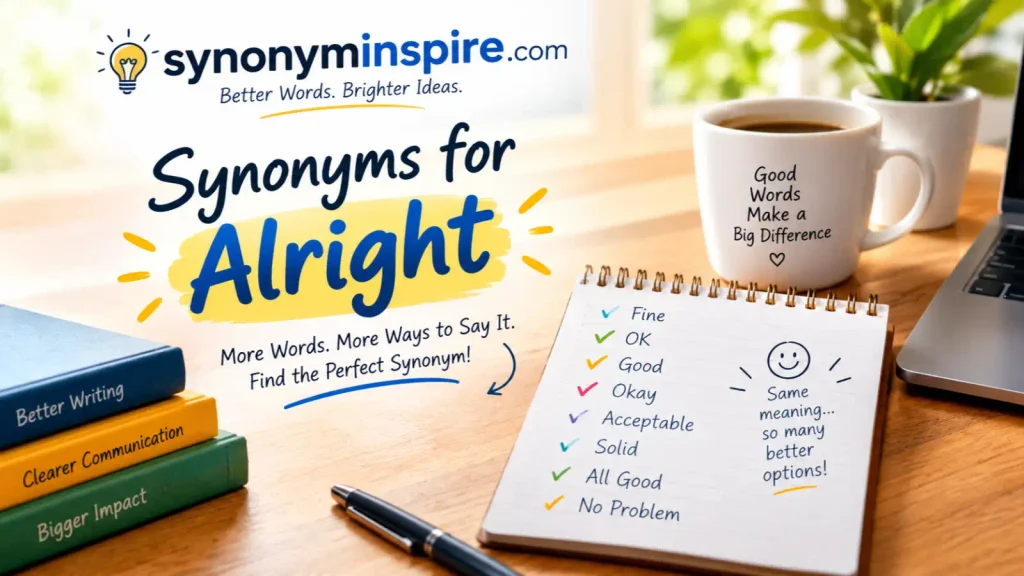
The best synonyms for alright include okay, fine, acceptable, satisfactory, good, well, agreed, certainly, and no problem. The right alternative depends on what you mean: giving approval, describing a condition, reassuring someone, or saying that something meets a requirement.
Although alright is common in everyday English, it can sound vague in professional emails, academic writing, and formal communication. Choosing a more precise word helps you express the right level of confidence, politeness, and approval without changing your intended meaning.
Quick Answer
Synonyms for alright include okay, fine, acceptable, satisfactory, good, well, agreed, suitable, adequate, and no problem. Use acceptable or satisfactory for formal writing, okay or fine for everyday conversation, and approved or agreed when confirming a decision. The best alternative depends on the sentence and intended meaning.
Quick List of Synonyms
Here are 35 useful alternatives, grouped by tone and meaning.
Closest alternatives
- Okay
- Fine
- All right
- Acceptable
- Satisfactory
- Good
- Well
- Adequate
Formal alternatives
- Appropriate
- Suitable
- Permissible
- Approved
- Authorized
- In order
- In good condition
- Meeting requirements
Neutral and professional alternatives
- Reasonable
- Fair
- Correct
- Valid
- Confirmed
- Agreed
- Understood
- No concerns
Casual alternatives
- No problem
- Sure
- Sounds good
- Yep
- All good
- Not bad
- Doing fine
Context-dependent alternatives
- Tolerable
- Manageable
- Healthy
- Safe
- Successful
- Acceptable to me
- That works
These expressions are not interchangeable in every situation. For example, approved means that someone with the relevant authority has given permission, while fine may simply mean that something is satisfactory.
Formal Alternatives to Alright
In formal writing, the best replacement depends on whether you are describing quality, granting permission, confirming a decision, or reporting a condition.
Acceptable
Meaning: Good enough to meet a standard.
Explanation: A close synonym when alright means that something is satisfactory, though it does not necessarily suggest high quality.
Example: The proposed schedule is acceptable to the project team.
Best Use: Workplace reports, evaluations, academic feedback, and formal discussions.
Worst Use: Situations where you need to express enthusiasm or exceptional quality.
Tone: Professional and neutral.
Satisfactory
Meaning: Meeting expectations or requirements.
Explanation: This word emphasizes that a result meets an expected standard. It can sound more evaluative than alright.
Example: The quality of the submitted work was satisfactory.
Best Use: Performance reviews, assessments, and quality-control reports.
Worst Use: Friendly messages where a warm, natural response is more appropriate.
Tone: Formal and measured.
Appropriate
Meaning: Suitable for a particular situation or purpose.
Explanation: Use it when alright means that an action, choice, or behavior is suitable rather than merely acceptable.
Example: Formal attire is appropriate for the ceremony.
Best Use: Workplace guidance, professional communication, and academic writing.
Worst Use: Describing whether a person feels physically well.
Tone: Professional and precise.
Suitable
Meaning: Right for a particular need or purpose.
Explanation: This is a contextual alternative when the original word expresses approval of a choice or option.
Example: This room is suitable for the training session.
Best Use: Recommendations, planning, and formal descriptions.
Worst Use: Responding to someone who asks whether you are feeling better.
Tone: Neutral to formal.
Permissible
Meaning: Allowed under a rule, policy, or standard.
Explanation: Unlike alright, this word specifically concerns whether something is allowed.
Example: Remote access is permissible under the revised policy.
Best Use: Policy documents, compliance guidance, and formal instructions.
Worst Use: Casual approval of a restaurant, outfit, or personal preference.
Tone: Formal and rule-focused.
Authorized
Meaning: Officially permitted by someone with the necessary authority.
Explanation: This is a narrower alternative. It indicates formal permission, not general satisfaction.
Example: Only authorized personnel may enter the laboratory.
Best Use: Security procedures, workplace policies, and official notices.
Worst Use: General comments about the quality of an experience.
Tone: Official and precise.
Approved
Meaning: Accepted or formally endorsed by the relevant person or organization.
Explanation: Use this word when a decision has received approval, not merely when it seems fine.
Example: The revised budget has been approved by the director.
Best Use: Business decisions, project updates, and administrative communication.
Worst Use: Describing your health or mood.
Tone: Formal and decisive.
Valid
Meaning: Legally, logically, or officially acceptable in a particular context.
Explanation: Valid is useful when the issue concerns whether a claim, document, reason, or argument meets relevant criteria.
Example: Your membership card remains valid until December.
Best Use: Documentation, academic reasoning, and formal verification.
Worst Use: Describing something as enjoyable or pleasant.
Tone: Professional and factual.
In order
Meaning: Correct, properly arranged, or free from an identified problem.
Explanation: This expression can replace alright when you mean that everything is in proper condition.
Example: The documents are in order and ready for review.
Best Use: Administrative updates and procedural checks.
Worst Use: Expressing excitement about good news.
Tone: Formal and restrained.
Adequate
Meaning: Sufficient for a specific need.
Explanation: Adequate emphasizes sufficiency, which may be weaker than saying something is good.
Example: The current staffing level is adequate for the event.
Best Use: Reports, planning documents, and resource assessments.
Worst Use: Complimenting someone on excellent work.
Tone: Objective and professional.
Compliant
Meaning: Following a rule, requirement, or standard.
Explanation: This is a contextual alternative, not a general synonym. Something can be compliant without being especially good.
Example: The equipment is compliant with the applicable safety requirements.
Best Use: Compliance reports, audits, and technical documentation.
Worst Use: Everyday conversations about personal well-being.
Tone: Technical and formal.
Reasonable
Meaning: Fair, sensible, or acceptable under the circumstances.
Explanation: Choose reasonable when you want to indicate that a decision, price, request, or proposal makes sense.
Example: The revised deadline is reasonable given the workload.
Best Use: Negotiations, business correspondence, and evaluations.
Worst Use: Confirming that a document has received official approval.
Tone: Balanced and professional.
Neutral and Semi-Formal Alternatives
These alternatives work well in everyday writing, workplace conversations, school assignments, and routine emails.
Okay
Meaning: Acceptable, satisfactory, or agreed.
Explanation: This is one of the closest everyday synonyms. It can express approval, a neutral opinion, or reassurance.
Example: The meeting time is okay with me.
Best Use: Casual conversation, messages, and ordinary workplace exchanges.
Worst Use: Formal reports that require a precise assessment.
Tone: Neutral and conversational.
Fine
Meaning: Acceptable or satisfactory; sometimes used to say that someone is well.
Explanation: Fine can suggest mild approval, but its tone depends heavily on context. A short reply such as “Fine” may sound reluctant.
Example: The proposed changes are fine for now.
Best Use: Informal updates and routine decisions.
Worst Use: Situations where you need to communicate strong enthusiasm.
Tone: Neutral, sometimes reserved.
Good
Meaning: Positive, satisfactory, or desirable.
Explanation: Good often conveys a more positive evaluation than alright.
Example: The revised introduction looks good.
Best Use: Feedback, progress updates, and general approval.
Worst Use: Describing something that only barely meets a minimum requirement.
Tone: Positive and accessible.
Well
Meaning: In good health or in a satisfactory state.
Explanation: Well works particularly well when discussing health or how someone is doing. It is not a direct replacement in every sentence.
Example: My grandfather is feeling well today.
Best Use: Health-related conversations and questions about personal condition.
Worst Use: Giving permission for a proposed action.
Tone: Neutral and natural.
Fair
Meaning: Reasonable, just, or acceptable.
Explanation: Fair is appropriate when assessing a price, decision, or arrangement. It may refer to fairness rather than overall quality.
Example: The revised payment terms seem fair.
Best Use: Negotiations, feedback, and everyday judgments.
Worst Use: Describing whether a person is medically healthy.
Tone: Balanced and measured.
Confirmed
Meaning: Verified or established as true or arranged.
Explanation: This word works when alright is being used to acknowledge an arrangement, but it communicates confirmation rather than general approval.
Example: Your appointment is confirmed for Thursday afternoon.
Best Use: Scheduling, bookings, and administrative updates.
Worst Use: Expressing that a meal tastes good.
Tone: Clear and professional.
Agreed
Meaning: Accepted by the people involved in a decision.
Explanation: Use agreed when everyone has reached a shared decision. It does not simply mean that something is satisfactory.
Example: The new deadline is agreed by both teams.
Best Use: Meeting summaries and negotiations. More naturally, write “Both teams have agreed to the new deadline.”
Worst Use: Describing your physical condition.
Tone: Neutral to professional.
Understood
Meaning: Comprehended or acknowledged.
Explanation: This is useful when alright means “I understand.” It does not necessarily show agreement.
Example: Understood. I’ll send the updated file this afternoon.
Best Use: Instructions, work messages, and practical coordination.
Worst Use: Responding to a question about whether a plan is enjoyable.
Tone: Direct and professional.
No concerns
Meaning: No problems or objections have been identified.
Explanation: This phrase can replace alright when confirming that nothing requires attention, although it is more specific.
Example: I reviewed the latest draft and have no concerns.
Best Use: Reviews, project updates, and workplace communication.
Worst Use: Expressing strong approval or excitement.
Tone: Calm and professional.
Manageable
Meaning: Possible to handle without unreasonable difficulty.
Explanation: Use manageable when a workload, problem, or situation is difficult but still within your ability to handle.
Example: The revised workload is manageable this week.
Best Use: Project planning, personal updates, and discussions about challenges.
Worst Use: Describing whether a claim is correct or a request is authorized.
Tone: Practical and reassuring.
Tolerable
Meaning: Possible to endure, though not necessarily pleasant.
Explanation: This word can sound more negative than alright. It suggests that a situation is bearable rather than good.
Example: The noise level was tolerable after the windows were closed.
Best Use: Describing discomfort, inconvenience, or difficult conditions.
Worst Use: Praising a successful project or welcoming a guest.
Tone: Reserved, sometimes negative.
Suitable enough
Meaning: Sufficiently appropriate for a particular purpose.
Explanation: This phrase conveys a limited level of approval. It is more conversational than a formal assessment and can imply that the option is not ideal.
Example: These chairs are suitable enough for a short workshop.
Best Use: Informal planning and practical decisions.
Worst Use: Formal evaluations that require a clear standard.
Tone: Neutral but qualified.
Informal Alternatives
Casual expressions are useful when a conversation calls for warmth, speed, or a relaxed tone.
No problem
Meaning: A task or request is not an issue.
Example: “Could you send that again?” “No problem.”
When natural: Friendly exchanges, routine requests, and casual workplace messages.
When to avoid: Formal evaluations where you need to state whether something meets a standard.
Tone: Helpful and reassuring.
Sure
Meaning: Willingness or agreement.
Example: “Can we meet at three?” “Sure.”
When natural: Accepting invitations, requests, and simple proposals.
When to avoid: Situations requiring explicit authorization or a documented decision.
Tone: Relaxed and cooperative.
Sounds good
Meaning: A plan or suggestion seems appealing or acceptable.
Example: “Let’s review the draft after lunch.” “Sounds good.”
When natural: Planning, friendly emails, and team chats.
When to avoid: Confirming legal, financial, or safety-critical details without checking them.
Tone: Positive and conversational.
Yep
Meaning: An informal version of yes.
Example: “Are we still meeting today?” “Yep.”
When natural: Text messages and relaxed conversations.
When to avoid: Formal letters, customer complaints, or official correspondence.
Tone: Very casual.
All good
Meaning: Everything is fine, or no problem remains.
Example: “Sorry for the delay.” “All good!”
When natural: Informal reassurance and quick status updates.
When to avoid: Technical reports or situations where a specific issue must be documented.
Tone: Friendly and relaxed.
Not bad
Meaning: Reasonably good, often with restrained praise.
Example: “How was the presentation?” “Not bad, actually.”
When natural: Casual opinions about experiences or results.
When to avoid: Formal performance assessments or situations that require clear positive feedback.
Tone: Understated and conversational.
That works
Meaning: A suggestion or arrangement is suitable.
Example: “I’ll drop off the package tomorrow morning.” “That works.”
When natural: Coordinating schedules, plans, and practical arrangements.
When to avoid: Confirming that something is legally approved or technically compliant.
Tone: Casual to semi-professional.
True Synonyms vs. Contextual Alternatives
Not every alternative communicates the same thing. This table shows how closely each category matches the original word.
| Type | What It Means | Can It Replace the Original? |
|---|---|---|
| True synonym | A word with substantially the same meaning in a specific context, such as okay for alright | Usually, if the context matches |
| Near synonym | A word with a similar meaning but a different tone or degree, such as fine | Often, but the nuance may change |
| Contextual alternative | A phrase that works only for a particular meaning, such as approved | Only in the relevant context |
| Broader expression | A phrase covering a larger idea, such as in good condition | Sometimes, if the sentence supports it |
| Narrower expression | A more specific term, such as authorized | Only when the specific meaning is intended |
The distinction matters because alright can perform several jobs. In “Are you alright?” it asks about someone’s condition. And In “Is it alright if I leave?” it asks for permission. In “The report is alright,” it evaluates quality.
The best synonym changes with each use.
Industry-Specific Usage
Business Writing
In business writing, replace vague approval with a word that makes the decision clear.
- Instead of “The proposal is alright,” write “The proposal is acceptable.”
- Instead of “The figures are alright,” write “The figures are accurate.”
- Instead of “The deadline is alright,” write “The proposed deadline is reasonable.”
Choose accurate only when the figures have been checked for correctness. Use acceptable when they meet the required standard, even if they are not perfect.
Corporate Communication
Internal reports and announcements often benefit from specific language.
- Approved: A decision has received the required authorization.
- Compliant: A process follows the applicable requirements.
- On track: A project is progressing according to its plan.
- Resolved: An identified problem has been addressed.
- Satisfactory: A result meets an expected standard.
For example, “The migration is on track” is more informative than “The migration is alright” if you mean that work is progressing as scheduled.
Academic Writing
In essays and research papers, alright can sound conversational or vague. More precise terms improve clarity.
- Use acceptable for a method that meets a stated standard.
- Use adequate for sufficient evidence or resources.
- Use valid for an argument or interpretation that meets relevant criteria.
- Use appropriate for a method suited to the research question.
- Use consistent when findings or results agree with one another.
Example:
Informal: The results are alright.
More precise: The results are consistent with the study’s original hypothesis.
The second sentence should be used only if the findings actually support that claim.
Customer Service
Customer-facing communication should sound polite and specific.
Instead of “Your order is alright,” consider:
- “Your order has been confirmed.”
- “Your payment was processed successfully.”
- “Your request is acceptable under our policy.”
- “Your issue has been resolved.”
- “Everything is in order with your booking.”
Choose the statement that matches what you have verified. Avoid telling a customer that an issue is resolved if it is still being investigated.
Legal Writing
Legal documents require precise wording. Alright is generally too vague for formal legal drafting.
Depending on the intended meaning, a document may use authorized, valid, permitted, compliant, or in accordance with the agreement. These terms carry distinct meanings and should not be substituted casually.
For example, saying that a payment is “alright” does not establish that it is legally valid, properly authorized, or compliant with a contract. The correct wording depends on the document and applicable law.
This is a language distinction, not jurisdiction-specific legal advice.
Email Communication
The right alternative depends on the message’s purpose:
- Approval: “The revised draft is acceptable.”
- Agreement: “That works for me.”
- Acknowledgment: “Understood. I’ll make the changes.”
- Reassurance: “No problem; I can help.”
- Status update: “The files are in order.”
- Confirmation: “Your appointment is confirmed.”
Clear wording reduces the chance that a reader will mistake acknowledgment for approval.
Email Examples: Better Ways to Say Alright
Email 1: Accepting a Meeting Time
EmailRe: Thursday’s Meeting
Re: Thursday’s Meeting
Hi Morgan,
Thursday at 10:30 a.m. works for me. I’ll bring the updated project notes.
Best,
Taylor
Alternative used: Works for me.
Why it fits: It confirms that the proposed time is suitable without sounding stiff.
Email 2: Reviewing a Draft
EmailFeedback on the Draft
Feedback on the Draft
Hi Priya,
I’ve reviewed the latest version, and the structure is acceptable. I’d recommend correcting the final paragraph before we publish it.
Thanks,
Daniel
Alternative used: Acceptable.
Why it fits: It communicates approval while making room for further improvement.
Email 3: Acknowledging Instructions
EmailRe: Updated Submission Guidelines
Re: Updated Submission Guidelines
Hello Jordan,
Understood. I’ll follow the revised submission guidelines and send the corrected document by Friday.
Regards,
Casey
Alternative used: Understood.
Why it fits: It confirms comprehension rather than implying that every instruction has been approved.
Email 4: Confirming a Booking
EmailYour Appointment Details
Your Appointment Details
Hello,
Your appointment is confirmed for Tuesday at 2:00 p.m. Please contact our office if you need to change the time.
Best regards,
Customer Support
Alternative used: Confirmed.
Why it fits: It gives the recipient a definite status rather than a vague reassurance.
Email 5: Responding to a Request
EmailRe: Additional Research Time
Re: Additional Research Time
Hi Evelyn,
No problem. You can have until Wednesday afternoon to complete the additional research. Please share the revised version when it’s ready.
Best,
Riley
Alternative used: No problem.
Why it fits: It sounds helpful and natural in a routine exchange.
Email 6: Reporting Project Progress
EmailWeekly Project Update
Weekly Project Update
Hello Team,
The project remains on track. The design review is complete, and testing is scheduled to begin on Monday.
I’ll share another update after the first round of testing.
Regards,
Alex
Alternative used: On track.
Why it fits: It communicates progress against a schedule rather than making a general judgment.
Short Dialogue Examples
Workplace
Person A: Can you review the presentation before noon?
Person B: Sure, I’ll look at it this morning.
Classroom
Person A: Is this explanation acceptable for the assignment?
Person B: Yes, but add one example to support your point.
Customer service
Person A: Has my appointment been arranged?
Person B: Yes, your booking is confirmed for Friday.
Casual conversation
Person A: How are you feeling after the long trip?
Person B: I’m doing fine now, thanks.
Professional discussion
Person A: Does the revised deadline seem realistic?
Person B: It seems reasonable given the remaining work.
Each response communicates something slightly different: willingness, evaluation, confirmation, personal well-being, or judgment.
Sentence Transformations: How to Replace Alright in a Sentence
The following examples show how a synonym can improve clarity without losing the intended message.
Example 1: Evaluating quality
Original: The presentation was alright.
Alternative: The presentation was satisfactory.
Why it works: Satisfactory communicates that the presentation met expectations, though it does not suggest exceptional quality.
Example 2: Confirming a plan
Original: Is 3 p.m. alright for you?
Alternative: Does 3 p.m. work for you?
Why it works: The replacement sounds natural and directly asks whether the time is suitable.
Example 3: Asking about health
Original: Are you alright after the fall?
Alternative: Are you feeling okay after the fall?
Why it works: The new sentence retains the concern about the person’s condition. If the fall may have caused an injury, ask about symptoms directly rather than relying on a general response.
Example 4: Granting permission
Original: Is it alright if I use your laptop?
Alternative: Would you mind if I used your laptop?
Why it works: The alternative makes the request more polite. It asks about the other person’s willingness rather than simply asking whether the action is acceptable.
Example 5: Evaluating a proposal
Original: The proposal looks alright.
Alternative: The proposal looks acceptable.
Why it works: Acceptable gives a clearer evaluation but may sound less enthusiastic than looks good.
Example 6: Acknowledging instructions
Original: Alright, I’ll update the spreadsheet.
Alternative: Understood. I’ll update the spreadsheet.
Why it works: The revised version makes it clear that the instructions have been understood. It does not automatically imply agreement with them.
Example 7: Assessing a budget
Original: The budget is alright for the event.
Alternative: The budget is adequate for the event.
Why it works: Adequate indicates that the available funds are sufficient for the stated purpose, not necessarily generous.
Example 8: Approving a schedule
Original: The revised schedule is alright.
Alternative: The revised schedule is reasonable.
Why it works: This works if the schedule is practical and fair. If someone has formally approved it, approved would be more accurate.
Example 9: Responding to an invitation
Original: Alright, I’ll join you for lunch.
Alternative: Sounds good. I’ll join you for lunch.
Why it works: The alternative adds a friendly, positive tone instead of sounding like reluctant acceptance.
Example 10: Describing a document
Original: The documents are alright.
Alternative: The documents are in order.
Why it works: This is more precise if you mean the documents are complete and properly arranged. It does not establish that every statement inside them is accurate.
Example 11: Reporting progress
Original: The team is alright with the current plan.
Alternative: The team agrees with the current plan.
Why it works: This version expresses agreement directly. Use it only if the team has actually reached a shared decision.
Example 12: Describing a difficult situation
Original: The workload is alright at the moment.
Alternative: The workload is manageable at the moment.
Why it works: Manageable explains that the workload can be handled, even if it is not light.
Comparison Table: Choosing the Best Alternative
| Phrase | Tone | Meaning / Scope | Best Use | Example |
|---|---|---|---|---|
| Okay | Neutral | Acceptable or agreed | Everyday conversation | The time is okay. |
| Fine | Neutral | Satisfactory or well | General responses | I’m feeling fine. |
| Good | Positive | Desirable or satisfactory | Feedback | The draft looks good. |
| Acceptable | Formal | Meets a standard | Evaluations | The result is acceptable. |
| Satisfactory | Formal | Meets expectations | Assessments | The work is satisfactory. |
| Appropriate | Professional | Suitable for a purpose | Guidance | That response is appropriate. |
| Adequate | Formal | Sufficient | Resource planning | The funding is adequate. |
| Reasonable | Professional | Sensible or fair | Decisions | The request is reasonable. |
| Approved | Official | Formally accepted | Decisions | The plan is approved. |
| Authorized | Official | Permitted by authority | Access and permissions | The user is authorized. |
| Valid | Technical | Meets relevant criteria | Claims and documents | The permit is valid. |
| Understood | Direct | Comprehended | Instructions | Understood; I’ll proceed. |
| Confirmed | Professional | Verified or arranged | Appointments | Your booking is confirmed. |
| No problem | Friendly | No difficulty or objection | Requests | No problem, I can help. |
| Sounds good | Casual-positive | A plan seems suitable | Informal planning | Sounds good to me. |
| On track | Professional | Progressing as planned | Project updates | The project is on track. |
| Manageable | Practical | Possible to handle | Workload discussions | The workload is manageable. |
| Tolerable | Reserved | Bearable but not ideal | Difficult conditions | The delay was tolerable. |
How to Choose the Right Alternative
A useful replacement preserves the message you intend to communicate.
- Formal writing: Choose acceptable, satisfactory, appropriate, or adequate, depending on the standard being discussed.
- Business communication: Use reasonable for practical proposals, approved for formal decisions, and on track for progress.
- Academic writing: Prefer valid, appropriate, adequate, or consistent when the specific meaning is supported by the evidence.
- Legal writing: Use the exact term that reflects the relevant rule, permission, obligation, or legal status. Do not rely on a general synonym.
- Professional email: Choose understood for instructions, confirmed for arrangements, and acceptable for evaluations.
- Everyday conversation: Okay, fine, and good are natural, familiar options.
- Casual messages: Sure, no problem, sounds good, and that works fit many friendly exchanges.
When uncertain, ask yourself: Am I expressing approval, agreement, permission, health, or quality? Answering that question usually reveals the best alternative.
Grammar and Usage Guide
Alright vs. All Right
Alright is a common informal spelling, but all right is the more widely accepted form in formal and edited writing. Some style guides prefer all right in nearly all contexts.
Examples:
- Informal: Everything’s alright.
- Formal: Everything is all right.
In professional documents, use all right unless your publication follows a different house style.
Use the Correct Part of Speech
Some alternatives describe a condition, while others communicate an action or decision.
- Adjective: The result is acceptable.
- Adverb: She performed well.
- Verb: The manager approved the request.
- Adjective or past participle: The request is approved.
- Phrase: The documents are in order.
Replacing a phrase without checking its grammatical role can produce an incorrect sentence.
Understand the Difference Between Approval and Agreement
Approval and agreement are related but not identical.
- “The manager approved the proposal” means the manager gave formal approval.
- “The manager agreed with the proposal” means the manager shared its view or accepted its terms.
- “The proposal is acceptable” means it meets a relevant standard.
Choose the statement that matches what actually happened.
Punctuation and Sentence Position
Alright and all right can appear at the beginning, middle, or end of a sentence, depending on their function.
- “All right, let’s begin.”
- “The revised version is all right.”
- “Is it all right to leave early?”
When using a transition such as all right at the start of a sentence, a comma often helps separate it from the main statement.
Common Collocations
Certain words pair naturally with particular nouns:
- Acceptable: acceptable standard, acceptable level, acceptable result
- Adequate: adequate resources, adequate evidence, adequate preparation
- Appropriate: appropriate response, appropriate method, appropriate behavior
- Valid: valid reason, valid document, valid argument
- Reasonable: reasonable request, reasonable price, reasonable deadline
- Confirmed: confirmed booking, confirmed appointment, confirmed details
These common combinations make writing sound more natural and precise.
Common Mistakes to Avoid
Treating Every Alternative as Identical
Fine, approved, and adequate do not mean the same thing. Check whether the sentence expresses quality, permission, agreement, or sufficiency before replacing the original word.
Using Overly Formal Language in Casual Conversation
Saying “Your suggestion is permissible” when a friend proposes a movie sounds unnatural. “Sounds good” is usually a better fit.
Confusing Understanding With Agreement
“Understood” means you have comprehended a message. It does not necessarily mean you agree with the instruction or approve of the decision.
Using Adequate as a Compliment
Adequate usually means sufficient. If you want to praise excellent work, use excellent, impressive, or well done, depending on the sentence.
Using Approved Without Actual Approval
A proposal is not approved merely because it seems reasonable. The word suggests that the required person or body has accepted it.
Making Reassurance Too Vague
If someone asks whether a problem has been fixed, “Everything is alright” may leave them unsure. “The issue has been resolved” is clearer when the problem has genuinely been addressed.
Ignoring Tone
A one-word response such as “Fine” may sound neutral, impatient, or reluctant. If warmth matters, try “That sounds good to me” or add a short explanation.
Replacing Words Without Checking Grammar
“She’s acceptable” and “She is well” have different meanings and grammatical uses. Make sure the replacement fits both the sentence structure and intended message.
When to Replace Alright—and When to Keep It
There are situations where a more specific alternative improves communication.
- Formal reports: Replace vague evaluations with terms such as acceptable, adequate, or satisfactory.
- Official decisions: Use approved or authorized only when the required approval or permission exists.
- Project updates: Choose on track, completed, or delayed to describe the actual status.
- Customer service: State whether a booking is confirmed, a payment was processed, or a problem was resolved.
- Academic writing: Use a precise term that explains the quality or status of the evidence.
- Safety-related communication: Say safe only when the relevant conditions support that conclusion.
However, alright and all right still have a place. In ordinary conversation, they sound natural and flexible. “Are you all right?” can express genuine concern, while “All right, let’s go” smoothly signals a transition. There is no need to replace a familiar expression simply to sound more sophisticated.
Advanced Tips for More Precise Writing
Match the Word to Your Intended Tone
If you want to sound encouraging, good or sounds good may be better than acceptable. If you need a neutral evaluation, satisfactory may be more accurate. For an official decision, use the relevant approval term.
Separate Politeness From Permission
A polite request does not establish that permission has been granted. “Would it be possible to leave early?” asks about an option, while “You are authorized to leave early” communicates permission from someone with authority.
Make Professional Emails Specific
Instead of writing “Everything is alright with the report,” identify what you checked:
- “The formatting is consistent.”
- “The figures match the source spreadsheet.”
- “The report meets the submission requirements.”
Specific language helps readers understand exactly what has been reviewed.
Avoid Inflating Simple Sentences
A synonym should make the message clearer, not more complicated. “The plan works” may be better than “The proposed arrangement is deemed to be satisfactory” in an ordinary team message.
Keep Your Meaning Consistent
Do not replace alright with successful unless you mean that something achieved its intended result. Similarly, safe describes an absence of unacceptable danger under relevant conditions, not simply something that seems fine.
Consider the Reader’s Expectations
A friend may appreciate “No problem,” while a customer waiting for a refund needs a clear update. Good word choice reflects the reader’s needs as well as the writer’s tone.
Related Questions
What is another word for alright?
Common alternatives include okay, fine, acceptable, good, and satisfactory. For agreement, try agreed or that works. For permission, use permitted or authorized when the context supports those meanings.
What is a professional alternative to alright?
Acceptable, satisfactory, appropriate, reasonable, and confirmed can work in professional communication. Choose the one that matches the sentence rather than selecting the most formal-sounding word.
Is alright formal or informal?
Alright is common in informal English and widely understood. However, all right is generally the safer choice in formal and edited writing because many style guides prefer that spelling.
What is the difference between alright and okay?
Both can mean acceptable or satisfactory. Okay is widely used as an acknowledgment, an expression of agreement, or an evaluation. Alright can serve similar functions, but the most natural choice depends on the sentence and the style guide being followed.
What is the difference between alright and fine?
Fine can describe health, quality, or acceptance, while alright can also indicate permission or signal a transition. Both may sound neutral, and fine can sometimes suggest reluctant acceptance depending on tone.
FAQs:
What is the best synonym for alright?
Okay is one of the closest general alternatives to alright. It works in many everyday sentences, but formal writing may call for acceptable, satisfactory, or appropriate instead.
How can I say alright in a more positive way?
Use great, excellent, sounds good, or that sounds wonderful when you genuinely want to express enthusiasm. These options are more positive than alright and should not be used if you only mean that something is barely acceptable.
What is a more polite way to say alright?
“That works for me,” “That would be fine,” and “Yes, that would be suitable” can sound polite when responding to a proposal. For requests, “Certainly” may work if you are agreeing to help.
Can alright mean that someone is healthy?
Yes. In a question such as “Are you alright?” the word often asks whether someone is safe, well, or emotionally okay. Depending on the situation, “Are you feeling well?” or “Are you feeling okay?” can make the question more specific.
Is acceptable stronger than alright?
Not necessarily. Acceptable is more formal and often more precise, but it usually means that something meets a minimum or expected standard. It does not automatically imply better quality or stronger approval.
Can I use alright in an academic essay?
You can use it in quoted dialogue or when discussing informal language, but it is usually better to choose a more precise expression in formal academic prose. Words such as adequate, appropriate, and valid may fit, depending on the intended meaning.
Should I write alright or all right?
All right is the safer choice in formal writing because many editors and style guides prefer it. Alright is common in informal usage, but consistency with the publication’s style guide matters most.
Key Takeaways
- Okay is a versatile everyday alternative, while acceptable and satisfactory suit more formal evaluations.
- Use approved, authorized, and permitted only when the context involves permission or a formal decision.
- Choose well when discussing health, and manageable when describing something that can be handled.
- In professional writing, a specific status such as confirmed, resolved, or on track often communicates more than a general statement.
- Keep alright or all right when it sounds natural; precise language is useful, but unnecessary formality can make writing less effective.
Conclusion:
Choosing among synonyms for alright becomes easier when you identify the message behind the word. If you are giving a general response, okay and fine are natural choices. If you are evaluating work, acceptable and satisfactory explain whether it meets expectations. For professional communication, appropriate, reasonable, confirmed, and understood can make your meaning more precise.
Some alternatives carry stronger implications than others. Approved suggests formal acceptance, authorized indicates permission, and adequate means sufficient rather than outstanding. Casual phrases such as no problem, sounds good, and that works are useful in friendly conversations, but they may not fit formal documents.
Before replacing the word, consider the sentence, your audience, and the tone you want to convey. Sometimes a specific synonym will improve clarity; other times, alright is perfectly natural. The goal is not to use the most complicated word, but to choose the expression that communicates your meaning accurately and comfortably.

Irene Strong is a passionate language writer and vocabulary enthusiast at SynonymInspire. She creates clear, useful, and engaging content on synonyms, word meanings, and English vocabulary to help readers find the right words with confidence.